
List of Pyrography Tools, Pyrography Equipment & Wood Burning Pen Tips
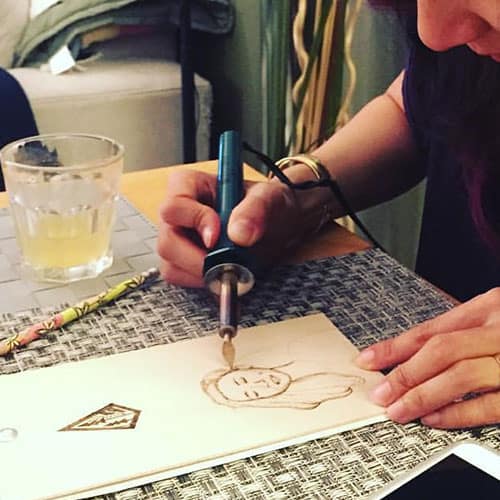
Pyrography is the art of burning wood to create designs, lettering, and other images. This art form has ancient roots, and evidence suggests that the Egyptians, Greeks, and other early civilizations decorated wood items using simple pyrography methods.
Today, pyrography continues to be practiced by artisans around the world. With instructions and tools readily available via the Internet, pyrography is more accessible than ever before.
The craft requires relatively few tools that can be purchased separately, or in affordable kits. Below are explanations of each tool and their uses in the art of pyrography, as well as advice for where to purchase each item.
List of Essential Pyrography Tools For Beginners
1) Wood

Most pyrography artists design on wood, but leather is also a common medium. Light toned hardwoods with a fine grain are best for pyrography. Basswood, beech, birch, and some types of pine are frequently used and offer the best, smooth work surface.
Planks and slices of wood are sold in rough or finished styles and can be purchased at most craft stores or online from art suppliers.

- BEST BARK EDGE - Created using a chemical-free, proprietary method that stabilizes and retains the...
- INSPIRATIONAL - Ideal for wood burning, home decor projects, crafts, hobbies, art, DIY wedding/event...
- PROJECT-READY - Sanded extra-smooth for a flat, clean, maker-friendly surface
2) Woodburning Pen
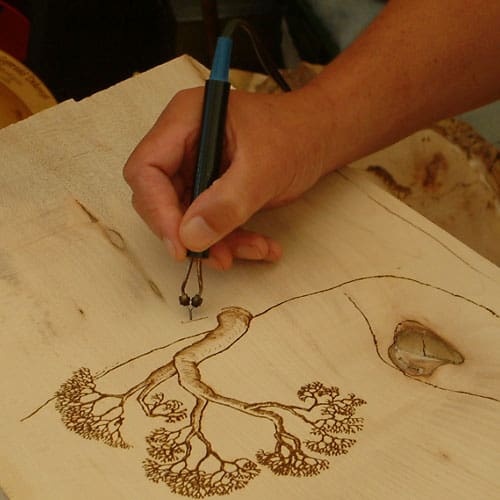
Woodburning pens are used to etch designs into wood. All pens have metal wire tips that come in many shapes and sizes. There are two main types of pyrography pens: fixed and interchangeable. Fixed pens have attached tips and are a good choice for beginners because they are simple to use.
They can be more expensive to collect than interchangeable pens, however, because if you want or need a different tip, you need to buy a whole new pen with the desired tip attached. Interchangeable pens offer more variety in tip styles and can be adapted to suit any project.
Some artists may find changing pen tips to be more work than simply reaching for another pen. Each type of pen has its pros and cons, and deciding between them is a matter of personal preference.

- REPLACEMENT PEN - We WILL replace the pen and broken tip
- THE DUAL POWER MODE - FOR US/CANADA/MEXICO - 110V ONLY. Using with any other voltage VOIDS THE...
- STURDY and EASY TO USE - TRUArt Superior-quality pen features a stainless steel barrel insulated...
3) Woodburner Unit


Woodburners supply the heat needed to etch designs into wood. They range in price, but good beginner woodburners can be purchased well within most peoples budgets (see below model). Popular brands include Colwood and Razertip, which offer a range of woodburners for beginner, intermediate, and advanced needs.
Woodburners provide heat to woodburning pens, which are discussed below. They have dials so artists can control the amount of heat depending on the project and the type of design being created.
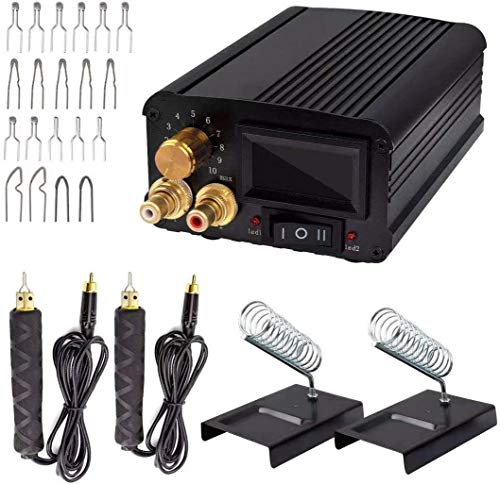
- USER FRIENDLY — The wood burning kit is easy to use and you can start your burnt art projects...
- ADJUSTABLE TEMPERATURE — Low and high volatge wood burner with digital accurate voltage control...
- HIGH EFFICIENCY — The two wood burning pens make less interruption when switching tips so the...
4) Woodburner Cord


When purchasing a woodburner, you will also receive a cord that attaches to the woodburner and the woodburning pen. These cords are the conduit for the heat used during the pyrography process and burn out with frequent use.
Pyrography supply stores and websites sell replacement cords separately that are compatible with the major woodburner brands.

- ➤ REPLACEMENT PEN/SPARE HAND PIECE - Designed for TRUArt 60W Professional Wood Burning Detailer
- ➤ EXTRA PEN, EXTRA FAST - Keep your projects flowing smoothly without long pauses waiting for tips...
- ➤ EASY DIY PROJECTS USING WOOD AND LEATHER - Writing or lettering, creating logos, portraits...
List of Pyrography Nibs for Woodburning Beginners
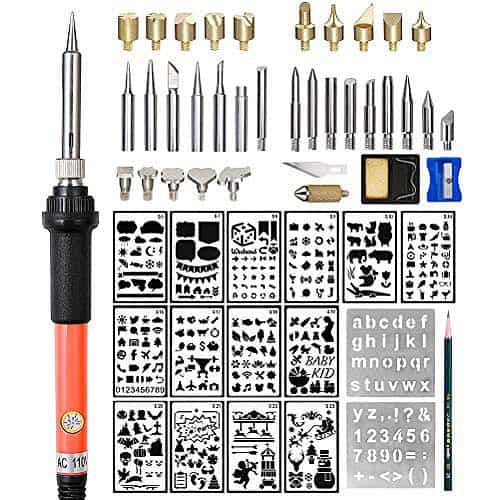
There are a multitude of pen tips, or nibs, on the market that suit the needs of different artists and project styles. Below are the most common tips and their uses in pyrography. Note that most of these tips come in sizes extra small, small, medium, and large.
Smaller tips are great for detail work, calligraphy, and delicate line work. Larger sizes will suit many projects and create bolder designs. Pyrography artists collect pen tips of many shapes and sizes depending on their art style and individual needs.
Beginners should familiarize themselves with a range of pen tips to better hone the craft!

- CARVING TIPS STENCIL - This set inclades 53 pcs diffarent bress taps and 12 Pcs stencils to help you...
- PERFECT FOR CARFT DESGIN--Helps in create a perfect an gd looking design on all tes of wood or...
- PREMIUM QUALITY--Easy to use, asy to take and say to clean. Made of high-strengthand heat-rstant...
1) Ball Tips
Ball tips glide over wood easily and are great for writing in cursive and drawing lines. These tips take longer to heat up and cool down due to their solid shape.
2) Skew Tips
Skew tips are angled with a sharp point at the end. are extremely versatile and used most often in pyrography. They can be used for cutting into wood and for fine detail work.
3) Round Tips
Rounded tips look like a horseshoe or the letter “C” and are used for shading and creating lines on uneven surfaces.
4) Tight Round Tips
Tight round tips are curved like rounded tips but are smaller and narrower in shape. These tips are best for general pyrography and detail on flat surfaces.
5) Flat Skew Tips
Flat skew tips are similar to skew tips but have a less pronounced angle and a blunt point. These tips are great for general pyrography.
6) Spear Tips
Spear tips have sharp, pointed ends that are good for general pyrography and for shaping detailed hair and feathers.
7) Chisel Tips
Chisel tips have a straight, flat shape and are used for general detail work, long straight lines, and shading work.
8) Round Skew Tips
Round skew tips are angled with a rounded end. These tips are great for pyrographers who create bird and animal carvings because they allow artists to create detailed and realistic feather and fur designs.
9) Writing Tips
Writing tips are curved and resemble standard calligraphy pens. They are most commonly used for writing but are also great for very fine detail work.
10) Curved Spear Tips
Curved spear tips allow artists to work in hard to reach places. They are pointed like spear tips but are angled to one side.
11) Knife Tips
Knife tips are general use tips that are both sharp and flat in shape. They are very popular for use on hair and feathers.
12) Shader Tips
Shader tips are flat and angled to glide easily over wood. As the name suggests, these tips are used to shade wood and are versatile in a range of projects.
13) Multi-use Tips
Multi-use tips are thin, curved and very durable. They are used for scaling, shading, and calligraphy. They make rippled effects on wood and are useful when adding detail to feathers and other organic shapes.
What Tips Should I Use?
With so many wood burning tips or nibs on the market, it can be difficult to know which ones to use for different techniques. Choosing the right tips also depends on your experience level and the types of artwork you create most often.
This video by Burn Savvy on YouTube is an excellent introduction to wood burning pen tips and their uses. Helpful advice is given throughout the video for beginner, intermediate, and experienced wood burning artists.
We highly recommend watching the video in full for all of Burn Savvy’s helpful insights, but we have also summarized the main points of the video here for your convenience.

Line Art and Lettering Tips
When doing line art, lettering, and small line work details, make sure to use wood burning tips with sharp edges, sharp points, and rounded points.
Straight and sharp edged tips allow you to achieve straight lines easily. The sharp edges prevent blobs and allow you to create lines, letters, grass, fur, and other details.
Because small tips are harder to control, rounded ballpoint pen tips are recommended for beginners. They create a slightly thicker line that is easier to clean up. More experienced wood burning artists can work with finer pen tips to create small lines.
While needle point pen tips are fun to use and are great for creating signatures and tiny details, they are also not recommended for beginners. They take a lot of control to use properly and can easily gouge wood if you are not careful.
Shading Tips
Shading can be achieved with a range of straight and bent shading tips in a variety of sizes. For large spaces, use a wide shader tip. This will make shading a lot faster and easier. You can achieve a more even shade by using a wide pen tip in open spaces as well.
For tight spots in your work, consider using narrower shader tips. These are able to get into hard to reach places much easier than a wide shader tip.
Any flat nib will work for shading. While shading tips are widely available, you do not need to use a nib labeled “shader” in order to achieve shading.
Bent vs. Straight Wood Burning Tips
Wood burning pen tips or nibs are available in flat or bent configurations. Each option is useful for different projects and surfaces.
If you are working on a flat surface, a bent tip will be easier to work with. It allows you to hold the pen straight without angling your wrist. This makes wood burning more ergonomic and will protect your hands and wrists while wood burning for long periods of time.
Straight or flat tips are ideal for working on concave or rounded surfaces like bowls or rims of plates. They allow you to work around the shape of the object without angling your hand in uncomfortable positions.
Heavy Duty vs. Standard Pen Tips
Wood burning pen tips come in a wide range of shapes, sizes, angles, and thicknesses. Heavy duty nibs are made from thicker wire than standard nibs. They heat more slowly but are much more durable.
Standard pen tips are light and heat quickly, but do not withstand high temperatures as well as heavy duty tips do.
Beginner wood burners should generally be burning with light pressure, low heat, and slow movements. This means that standard pen tips can be a good option. They are affordable, easy to find, and perform well at lower pressures and temperatures.
However, if you are planning to continue wood burning for years to come and want to advance in the art form, buying heavy duty pen tips from the outset is probably the better option.
Heavy duty pen tips perform better at all heats and pressures and will generally last much longer than their standard counterparts.
How can I get some of them
Where can I buy Pyrography writing nibs which were not included in full kits?