

List of Famous Mythological Swords & Legendary Swordsmen [Updated]
Heroes of myths and legends usually wield weapons of extraordinary strength and ability. Regardless of the culture and country the myth originates from, the use of swords in ancient stories is a common feature.
From a literary perspective, swords complement a hero’s physical capabilities, or enhance a certain characteristic of the hero and make the story more multidimensional.
For bladesmithing and sword making enthusiasts, the descriptions of the swords themselves are valuable in understanding different styles of historical swords and the influence weapons had on both everyday life and the imagination.
Here are 12 swords from European, Middle Eastern, and Asian mythology that are sure to impress.
1) Excalibur
(Britain)

Excalibur is the most famous sword on the list, and has been featured in countless movies, tv shows, video games, historical documentaries, and books.
Said to be the sword of King Arthur, Excalibur is Britain’s legendary weapon that possesses a few very powerful abilities. When first drawn, Excalibur’s blade blinds its wielder’s enemies. This is due to it being “lit by 30 torches.” The sword’s scabbard is also able to protect its bearer from physical harm.
The many translations of King Arthur’s stories muddle the identity of Excalibur. In some versions of the tales, Excalibur is the same weapon as The Sword in the Stone. Other translations differentiate between the two swords.
2) Arondight
(Britain)


Arondight is another sword from the Arthurian legends of early Britain. It is the sword of Sir Lancelot, one of the knights of the Round Table.
3) Joyeuse
(France)

.jpg)
Legend has it that Joyeuse is the sword of Charlemagne, who was a real historical figure in early French history. The weapon is said to be forged from the materials used to create Durendal, which is discussed below.
4) Durendal
(France)

.jpg)
Durendal is the sword of Roland, a military leader under Charlemagne and one of the main characters in the Matter of France, a medieval history of the country.
According to legend, Durendal is the sharpest sword in existence and is indestructible.
5) Caladbolg
(Ireland)

Caladbolg is the iconic sword of Fergus mac Roich in the Ulster Cycle of Irish Mythology. In these stories, the weapon is described as being a double handled sword that emits rainbows when swung. Caladbolg has the power to slice the tops off of three mountains in one stroke.
6) Gram
(Norway)


Gram is one of the most famous swords in Norse mythology. Gram is wielded by Sigurd in the Volsunga Saga to slay the fearsome dragon Fafnir. The sword has the power to slice an anvil in half.
7) Sword of Peleus
(Greece)
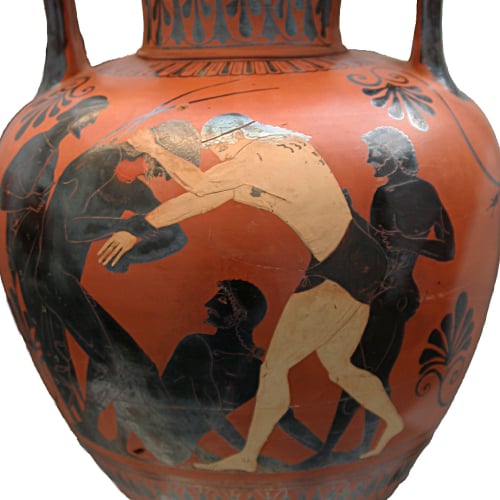

The Sword of Peleus, father of Achilles is a legendary weapon featured in ancient Greek mythology. The sword grants its wielder victory in any battle or hunt.
8) Harpe
(Greece, Rome)


Harpe is a sickle-type sword used by Perseus to slay Medusa. This type of weapon is referenced in Greek and Roman mythology. It is also included in statues of mythological heroes from this culture.
9) Zulfiqar
(Modern-day Saudi Arabia, Middle East)

_MET_h1_57.51.9.jpg)
Zulfiqar is a scissor-like sword with two blades that is depicted on historic flags from the Middle East and is referenced in stories. It is believed that the Archangel Gabriel gave Zulfiqar to the Prophet Muhammad.
10) Shamshir-e Zomorrodnegar
(Persia)
_with_Scabbard_MET_DP164593.jpg)
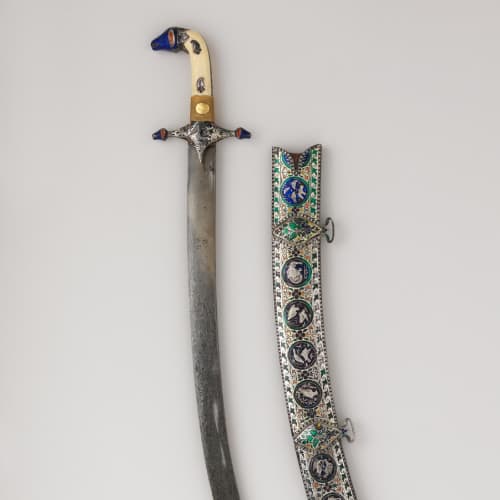
Shamshir-e Zomorrodnegar is an emerald-studded sword featured in the story of Amir Arsalan. It is a weapon capable of defeating Fulad-zereh, a horned demon.
11) Dojikiri Yasutsuna
(Japan)

Dojikiri Yasutsuna is used by Minamoto no Yorimitsu, a hero of Japanese legends, to slay the terrible ogre Shutendouji.
12) Kusanagi no Tsurugi
(Japan)


Kusanagi no Tsurugi is Japan’s most legendary sword. In Shinto mythology, the storm god Susanoo discovers this blade in the corpse of the Orochi Serpent. The sword represents the Virtue of Valor and is one of the Imperial Regalia of Japan.
13) Cheng Jing
(China)


Cheng Jing is one of China’s ten legendary swords. It is known as the sword of elegance and has a surprising feature. According to legend, the sword’s blade is only visible at dawn and dusk.
Although invisible most of the time, the blade has the power to fell several trees at once.
Cheng Jing was supposedly crafted in the Shang Dynasty (1600-1100 BC) and owned by Kong Zhou during the Spring and Autumn Period. The sword is featured in writings by philosopher Liezi, who is pictured above.
14) Gan Jiang & Mo Ye
(China)

.jpg)
The swords Gan Jiang and Mo Ye, also known as the swords of love, have a fascinating story that dates to the Spring and Autumn Period of Chinese history.
According to one version of the legend, the swords Gan Jiang and Mo Ye were forged by a blacksmith named Gan Jiang, who had a wife named Mo Ye. Gan Jiang was commanded to make a sword for the king but was having trouble getting the fire hot enough to forge.
Mo Ye offered to throw herself into the flames to get the fire hotter, knowing that her husband would be executed if he failed to deliver a completed sword to the king. She did so, and Gan Jiang was distraught.
He created the swords of love after her death, but kept the one named Mo Ye for himself. When the king found out he withheld one of the swords, he was furious and executed Gan Jiang. After his death, the Gan Jiang sword disappeared, while the Mo Ye sword turned into a dragon.
Six hundred years later, the sword turned up near a small village and was attracted to a dragon living there. It too turned into a dragon, and so husband and wife were reunited. The next day, a new human couple was living in the village, the husband a talented blacksmith, the wife a doting assistant.
15) Ascalon
(Mediterranean/Europe)


Ascalon is the famed sword of Saint George. This celebrated Catholic saint was a real figure whose story became legend in the middle ages. Saint George and his legendary sword became symbols of chivalry, bravery, and the Christian faith in medieval times.
In the story, Saint George rescues a princess who would have otherwise been eaten by a feared dragon. He wielded a sword named Ascalon and used it to behead the dragon.
The story takes place in Silene, which is thought to be in modern day Libya. The story of Saint George is therefore one of Mediterranean and European significance.
While fictionalized, the life and legend of Saint George remains significant to many to this day. His story is widely celebrated in England, Georgia, and other countries.
16) Dainsleif
(Norway)


Dainsleif is a legendary sword from Norse mythology that shares some characteristics of other famous swords from this culture. The sword is featured in Prose Edda by Icelandic historian and writer Snorri Sturluson.
The story goes that Dainsleif was forged by a dwarf named Dain. If the bloodthirsty sword was drawn from its sheath, it would have to kill someone.
Dainsleif features heavily in the story of King Hogni and his daughter Hild. King Hogni arrives at a meeting with other leaders and brings Hild along. One of the other kings kidnaps Hild and Hogni furiously pursues him.
Hild tries to compromise with Hogni, but he refuses and draws Dainsleif. Now the sword must see battle. The two kings fight, and after each battle Hild revives the soldiers with her magic.
The battle continues with previously slain soldiers fighting over and over again. The battle goes on in this way for 143 years.