

Accounts of Female Blacksmiths & Blacksmithing Throughout History
When we think of blacksmithing, the image that likely comes to mind is one of a hulking man laboring over a dusty anvil. Due to biased historical documentation, the sheer physicality of the craft, and the many male blacksmiths we see in movies and video games, blacksmithing has been misinterpreted as a males-only profession.
While it is true that the majority of blacksmiths at work in history and in modern times are men, women around the world have practiced blacksmithing for hundreds of years and continue to contribute to the metalworking industry. A few notable time periods for women in blacksmithing will be discussed in this article: the Middle Ages, the colonial period, and the present day.
Female Blacksmiths of the Middle Ages
Women have been working as blacksmiths for centuries and some of the earliest documentation dates back 800 years. In as early as the 14th century, blacksmith guilds (and organizations for other trades dominated by male workers) began inviting widowed wives of craftsmen to continue running the family business in their husbands’ place.
Once they successfully took over for their late husbands, blacksmithing widows could register their own maker’s marks and join guild rolls.

There are several primary documents that prove the existence of female blacksmiths during this time period. The Holkham Bible of the 1300s, for example, includes an image of a woman forging a nail (above). It is assumed that this woman is the wife of a blacksmith and that is why she is shown working at the anvil, but regardless of her position, the illustration provides a glimpse into the work of women in the middle ages and their many roles.

Another example of medieval female blacksmiths is a woodcut (above) from the 1300s that depicts an armorer and his apprentices, one of which is a woman. While she is not a master blacksmith herself, this artifact shows that women were educated in work that was traditionally considered “men’s work.” As an apprentice, this woman would have been able to eventually take on a higher position within the metalworking field or use her skills to pursue other avenues of work.
Female Blacksmiths in the 18th Century
Moving forward in history, women continued to find work as apprentices and blacksmiths. The dawn of the Industrial Revolution at the end of the 18th century ushered in a new era of work in Europe and America. Entire families moved into urban areas to join the thousands working in factories and other industrial settings.
While most women continued to work within the home as wives and mothers, others opted to contribute to the family income by seeking employment outside the domestic sphere.
By the 1700s, women in London were allowed and even encouraged to learn a trade and take on their own apprentices to help them.
In the smithing town of Birmingham, England in the mid 18th century, it was not unusual to see women forging nails. In fact, female nailers outnumbered males in several major manufacturing districts.
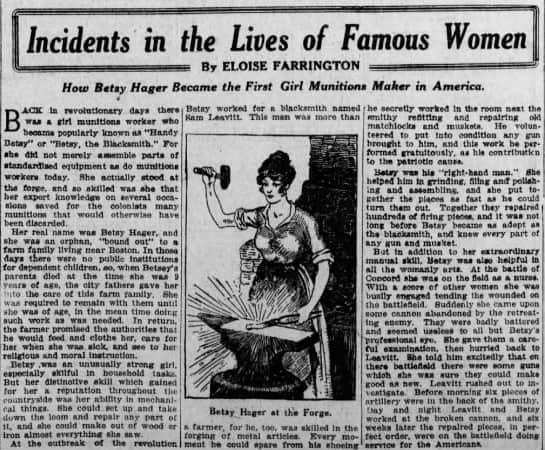
One blacksmith named Elizabeth Bennett worked in Blenheim Palace in Oxfordshire and is noted to have made equipment for tending the grounds. Another notable blacksmith of the time was Betsy Hager, who refurbished antique muskets for soldiers fighting in the American Revolution.
While more women joined the workforce in blacksmithing and other manufacturing roles, the number of female apprenticeships remained quite small. Most women learned trades from their fathers or other male family members. .
How Common Were Female Blacksmiths in History?
While the examples discussed above illustrate the existence of women in blacksmithing, it does not mean it was a common occurrence. Dorothy A. Mays, author of Women in Early America: Struggle, Survival, and Freedom in a New World, reminds us that “although it is true that there were extraordinary cases of female blacksmiths, newspaper editors, and other skilled professionals, such women were anomalies.”

Most women became wives and mothers, general laborers, or were fortunate enough to marry into wealth and run a large household. Blacksmithing would not have been an option for such women and most women would not choose a career in blacksmithing over the more stable and socially acceptable role of mother and wife.
Census records throughout the 19th and 20th centuries are helpful to our understanding of female blacksmiths and their roles in society. Records indicate that female workers in blacksmithing and related occupations were extremely rare. The 1890 census reports only 58 out of the country’s 205,337 blacksmiths were women.
Although many women did not pursue a career in blacksmithing, this did not mean they could not if they had the means to. A common misconception regarding female blacksmiths in history is that they were not ‘allowed’ to do the work of men and that is why there were relatively few women working in blacksmithing and other male-dominated trades.
In reality, medieval guilds and other trade organizations that emerged throughout history generally had no issues with women taking over their husbands’ businesses or becoming apprentices. Women were expected to be widowers or to have learned the trade from family members. A young and single women desiring to learn the trade would likely have raised eyebrows.
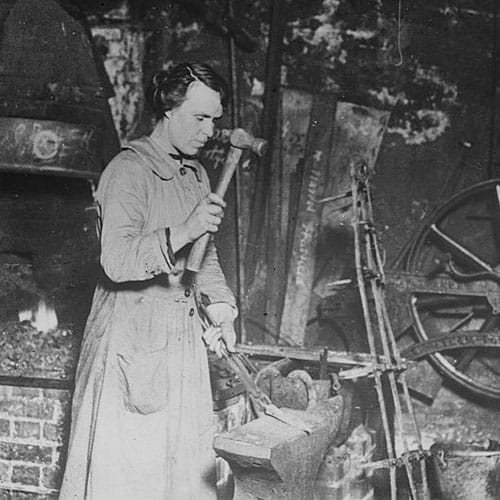
Blacksmithing and Women Today

Thanks in part to the presence of female blacksmiths in history, there are thousands of successful and talented women employed in metalworking professions today. Female blacksmiths are no longer quite the anomaly they were in the past, but there are still relatively few women in the field compared to men. Still, they enjoy great respect and success and work hard to share their talents with clients.
One very successful female smith is Caitlin Morris. She runs her own blacksmithing school called Ms. Caitlin’s School of Blacksmithing in Frederick, Maryland. She is a celebrated blacksmith with over ten years of experience and a rigorous education background. Morris has completed dozens of courses with blacksmith guilds and has taught many classes around the US as well.
Another renowned American blacksmith is Dorothy Stiegler, a blacksmith with over forty years of experience. She is a past president and board member of ABANA- the Artist Blacksmith Association of North America and won ABANA’s most prestigious award, the Alex Bealer Award, in 1998 for her contributions to the blacksmithing industry.
Bex Simon, a blacksmith from Surrey, UK is another celebrated female smith with years of experience and dozens of awards to her name. She creates beautiful works of art for the home such as gates, furniture, lighting, and railings.
The women described here are only a few of the many talented female smiths working today. Other industry leaders include Lorelei Sims, Elizabeth Brim and Avril Wilson. Each smith brings her own unique artistry and preferences to the industry and creates works of art that are functional and beautiful.
Female blacksmiths working in today’s modern society face challenges of their own, but also enjoy recognition within the blacksmithing industry and are celebrated for their hard work and innovation. From the middle ages to the present day, there has always been a place for women in blacksmithing.
I have a little pamphlet on chain making and there were many women chain makers in the Black Country, England.