
The Best Types of Blacksmith Forges & Fuels (Reviews & Comparison)

The blacksmith’s forge is an essential component of the blacksmithing trade, and could even be considered the very heart of the metal working process. Although they can look complex and intimidating, their shared function is actually pretty simple – heating up metal stock sufficiently so you can hit it with your hammer!
However, within the modern trade there are now countless numbers of forges, models and fuels available to blacksmiths and hobbyists of all skill levels, ranging from portable propane burners to industrial induction heaters.
This array of choices can be daunting, but having the knowledge of which fuels and forges are most appropriate for your purposes and which are most compatible with each other will allow you to narrow down your list.
Luckily, we have listed some common types of fuels and forges used in blacksmithing with informative descriptions to help you make an informed choice when searching for blacksmithing equipment that will best suit your needs.
Best Blacksmith Forge? We Recommend:

What Type of Fuel is Best for Blacksmithing?
1) Lump Coal

Lump coal, or lump charcoal, is the product of slowly burning hardwood in the absence of oxygen. The charcoal burning process takes place under pressure and removes the impurities of the wood or plant, therefore leaving the carbon residue known as a charcoal as the end product. It is made up of larger pieces of charcoaled wood, which are characterized as lumps. The larger, unprocessed pieces of coal signify their status as the most natural form of charcoal.
Burning lump charcoal has many advantages over burning wood in many applications due to the absence of the impurities found in wood. Since wood contains water and other organic components, it tends to release more steam and volatile particles in the form of smoke when burning, oftentimes creating soot. Lump charcoal, on the other hand, gives off much less smoke and can even reach higher temperatures than wood. Due to its sensitivity to oxygen reactions, lump coal can reach very high temperatures when burned for fuel. Because of this characteristic, the temperature of the forge fueled by lump coal can be easily controlled by adjusting the airflow to the forge.
Lump charcoal is widely available and its cost is relatively low for the quality of its fuel, but it can be considered more expensive than other types of forging fuels. It is a purer form of charcoal that burns at high temperatures, generates a steady flame, and leaves very little ash once burned. Many blacksmiths find lump charcoal to be highly effective and easy to control when forging metals, especially iron metals. This type of fuel is effective in both small and large scale forging.
2) Charcoal Briquettes

Charcoal, more specifically charcoal briquettes, is a similar type of fuel that is made by burning wood under pressure over a longer period of time. In contrast with lump charcoal, charcoal briquettes are characterized by relatively smaller pieces of coal. This type of fuel, although very similar to lump charcoal, contains many more additives and does not reach the same high temperatures as lump charcoal does.
The reason for the additives found in charcoal briquettes is mainly the nature of their starting materials. Charcoal briquettes are formed from the burning of wood and sawdust in the absence of oxygen, which creates a different product from the burning of pure hardwood. The smaller, compressed shapes of charcoal briquettes are not natural-looking because they are manually shaped that way once chemical binders and fillers are added to the mixture. Charcoal briquettes take a longer time to start a fire and burn at lower temperatures. The chemical binders in the briquettes also give off unpleasant smells and air pollutants when they first start to burn.
Although the temperature is not as high as that achieved by lump charcoal, briquettes burn at a steadier temperature. Despite the downsides, charcoal briquettes remain a widely-used reliable and cheap alternative to lump charcoal for forging with metals that melt at temperatures between 700°C and 800 °C. This type of fuel is effective for small scale forging, but may contribute a lot of air pollutants when used in a large scale setting.
3) Propane Gas
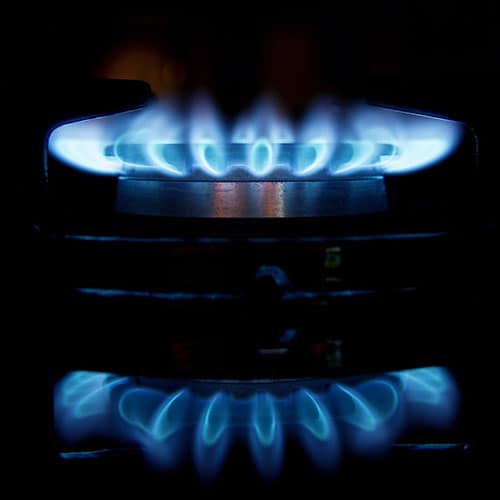
Propane gas is a great fuel for forging. It is also known as liquified propane gas, refering to the manner in which it is compressed and stored as a liquid, making it portable. Propane is a three-carbon gas alkane in standard conditions. It is produced as a by-product of the alkylation process for refining petroleum. Propane was discovered in the mid-19th century by French chemist Marcellin Berthelot and readily commercialized by the U.S. in the early 20th century.
Propane immediately vaporizes once it exits its container due to its low boiling point. It can burn at high temperatures than both lump charcoal and charcoal briquettes, so it is a viable fuel competitor in terms of fuel quality. Propane gas does not smoke, it burns cleanly and is considered a clean fuel. In addition to these great properties, propane is also a more affordable fuel than charcoal and lump coal.
4) Thermal Induction

Thermal induction is a method of heating objects through electromagnetic induction. It is made up of an electromagnet and an electronic oscillator that passes an alternating current at high frequencies to generate resistive heat from eddy currents. The electromagnet consists of a metal coil through which a metal object can be placed and heated. The basic principles behind inductive heating were developed by the work of Michael Faraday in the 19th century.
This is a relatively modern way of heating up metal and it is not prevalently used by many blacksmiths compared to the other fuels listed, despite its high efficiency. Induction heating can be easily set up in normal residencies with AC current. The actual equipment and electrical knowledge needed to set up your own induction heater may be a little more complex than that required by other forging methods, so it may cause some blacksmiths to shy away from it.
Some induction heaters can reach temperatures up to 1000°C and can successfully soften and melt some metals for the purposes of forging. This type of forging may be best used by advanced blacksmiths.
Pre-Built Forges vs. Homemade Forges – What’s Better?
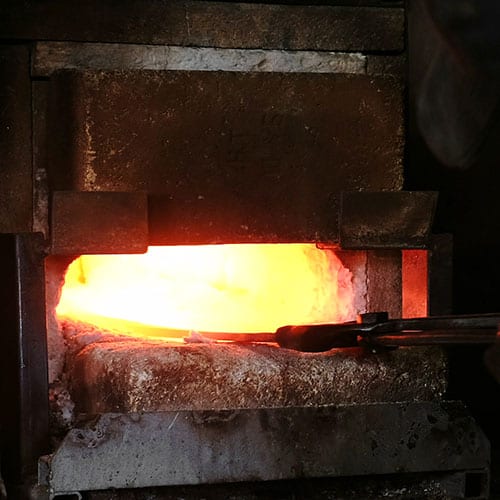
Before discussing the types of forges available to buy, it is important to consider the possible advantages and disadvantages to building your own blacksmith forge.
Generally, building your own forge is more cost-efficient than purchasing a pre-built forge. Many blacksmiths build their own forges with materials they can find around their house or easily accessible at home improvement retailers.
Although not recommended, you could even start with just a JABOD, ‘just a box of dirt’, when starting out as it’s that easy to get into forging when without any upfront costs (although obviously not ideal in the long term!).
If you’re wanting something a little fancier, building an actual forge also allows you to size it and design it in a way that will best work for your desired purposes, which can be useful if you’re already experienced and know exactly what you need from your equipment. Although it takes a little more time and planning, building your own forge can also be a very rewarding process.
If you are a beginner, or simply want to start blacksmithing with as little fuss as possible, it may be more convenient for you to purchase a pre-built forge. Purchasing a professionally-built forge can save you time and ensures that it is designed for that specific purpose without the need of any additions. As well as this, many professional forges come with lengthy warranties for maximum peace of mind in case of equipment failure, or in case you need support.
The Best Blacksmith Forges (Propane, Coal & Induction)
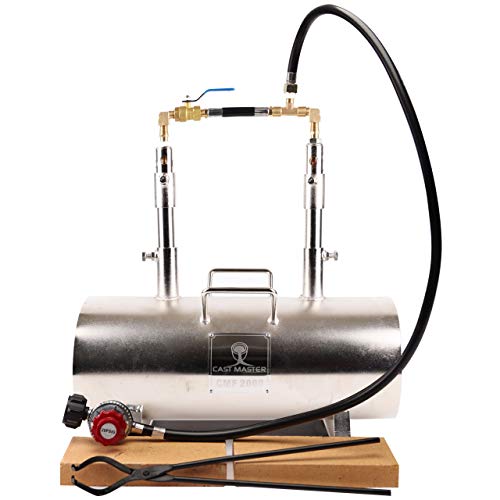
1) USA Cast Master Elite Portable Double Burner
- Powerful Dual Burners: Equipped with two high-efficiency burners for rapid heating, providing...
- Durable Construction: Made from heavy-duty steel and insulated with fire-resistant materials...
- Large Forging Space: Spacious work area accommodates larger projects, allowing blacksmiths to work...
If you’ve ever dreamed of shaping metal with your own hands, the Cast Master Elite could be the forge that turns those dreams into reality. From our experience, this powerhouse of a forge brings the heat – quite literally – and it’s been a real game-changer in our DIY blacksmithing projects.
We noticed right away how fast the Cast Master Elite reaches a high temperature. This means we spend less time waiting and more time hammering, bending, and crafting our metal works. The forge’s dual burners provide an even and consistent heat, critical for those intricate projects that require precision. And to sweeten the deal, the included fire bricks and kaowool insulation keep the heat focused where you need it. The convenience continues with the easy-to-follow online and paper instructions that Cast Master provides, getting you up to speed in no time.
Also, with any high-temperature forge, safety is paramount. We found it’s best to have a safe setup location away from any flammable materials and ensure you’ve got protective gear to prevent burns.
For blacksmiths, farriers, and hobbyists seeking to make their mark in metalwork, we find the Cast Master Elite to be a solid choice.
With its quick heating times, ample insulation, and ease of use, we’re confident in recommending this forge. Not to mention, support from Cast Master is just an email away if you hit a bump.
Ready to bring the heat to your metalwork? Check below for the current best prices!
| Advantages | Disadvantages |
|
|
2) CAST Master Elite USA Portable Single Burner
- MAKE BLACKSMITHING FUN AGAINWe get ityou don't have unlimited time. But you do have a long list of...
- STATE OF THE ARTWith a single burner, heat maximizing oval shape, and vertical firing system, you...
- WORKS ON MOST METALSGold, Brass, Bronze, Magnesium, Aluminum, Tin, Stainless Steel...all can be...
Crafting with metal requires a forge that’s both reliable and easy to work with. We’ve been working with the Cast Master Elite SS and it’s apparent it answers the needs of both budding and experienced metalworkers.
Its single burner blasts out significant heat, reaching upwards of 2400 degrees Fahrenheit, making it suitable for a variety of metals like gold and stainless steel. The unit’s oval shape is a clever design that maximizes heat distribution, and we’ve noticed it indeed streamlines the heating process. The forge is user-friendly too. It arrives almost fully assembled, with a handful of components to manage, and we were able to get it fired up in no time. Though the instructions could be clearer, most of us will navigate the setup smoothly with a bit of common sense.
What’s clear from our use is that the build is solid, with components that feel robust and reliable. On the flip side, the kaowool lining might require additional sealing with rigidizer for better durability and safety, which is an extra step some may not anticipate.
For anyone keen to step into the world of metal forging or who needs a solid and simple forge for their crafts, the Cast Master Elite SS fits the bill. It heats up fast and maintains high temperatures effortlessly, which is essential for efficient metalworking.
Interested in giving it a go? Click below to check current prices!
| Advantages | Disadvantages |
|
|
3) Whitlox Wood-Fired Forge
No products found.
Our recommendation for a forge that uses coal or wood as fuel is the Mini Whitlox Wood-Fired Forge from Whitlox Forge. This forge can be easily ordered online and costs less than either of the propane forges previously discussed. It is, however, important to note that the cost of coal or wood fuel is higher than that of propane gas, so although the capital cost of this forge may be much less than that of the previous forges, but its operation cost may be higher.
However, if you’re looking for a coal forge, the Mini Whitlox forge has a very traditional aspect to it and is designed in such a way to allow for the fuel to be easily heated up along the middle of the forge, cultivating the desired conditions needed to reach higher temperatures during forging. It is made up of firebricks that retain heat for a smokeless fire. The steel body is insulated from the heat of the bricks with kaowool insulation.
The size of this forge is also small enough that it can be portable. The vendor also offers a few optional accessories that that customer can purchase with the forge depending on the individual customer’s needs. This forge would be great for a beginner or blacksmiths of all skill levels who have smaller projects, or those looking for a more ‘traditional’ forging experience.
| Advantages | Disadvantages |
|
|
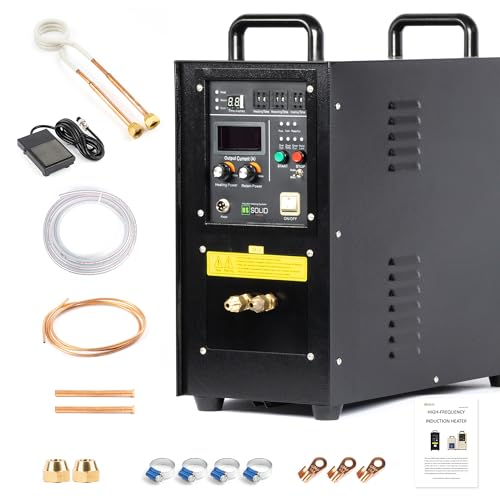
4) US Solid Thermal Induction Forge
- Advanced MOSFET and IGBT Inverter System: Built with MOSFET and IGBT power devices combined with...
- Improved Energy Efficiency: Compared to conventional electron tube high-frequency heating systems...
- 100 percent Continuous Full-Load Operation: Industrial-grade 100 percent full-load design supports...
As for thermal induction forges, one of the most feature-rich and cost-effective models is the U.S. Solid 15kW High Frequency Heater. Although cheaper than some other induction heaters, this forge is the most expensive of all the forges we have mentioned here.
This type of forge is definitely more appropriate for experienced blacksmiths who are able to invest in this equipment technically and make full use of it. This heater has a built-in cooling water system and an alarm that goes off if it starts to overheat during operation. The unit can operate 24 hours a day without any breaks, if necessary. The temperature can easily be controlled by using its control panel, with the maximum heating temperature being 1200°, which is very standard for the other types of forges as well.
The vendor includes a complimentary heating coil and copper tube. If there are additional sizes that you would like for a specific applications, the vendor even allows you to submit an order for a coil of a different size. Overall, it works at a high efficiency and can save you money in the long run due to its much lower operating costs. The vendor includes a complimentary heating coil and copper tube. If there are additional sizes that you would like for a specific applications, the vendor even allows you to submit an order for a coil of a different size.
| Advantages | Disadvantages |
|
|