List of Historical & Modern Swords of Southeast Asia [Updated]
Southeast Asia is a region comprised of eleven sovereign states and a large number of ethnic groups.
The countries of Brunei, Cambodia, East Timor, Indonesia, Laos, Malaysia, Myanmar, Philippines, Singapore, Thailand, and Vietnam are all located in Southeast Asia.
These countries include diverse people groups who have unique cultures and histories. Many of these groups also share common elements of their culture.
Swords are important objects within Southeast Asian cultures. The people groups native to this region, and especially on the Indonesian islands, have engaged in widespread trade and exchanged weapons with each other.
The following swords, daggers, and knives originate in Indonesia, Philippines, and other areas of Southeast Asia. Many share similar characteristics, or have historically been used in more than one country.
In general, Southeast Asian swords are distinguished by their mythical components, decorative hilts, and unique blade shapes.
Because the study of Southeast Asian weapons is complex, we have included the most well-known and collected blades of the region. These weapons have significant historical and cultural impact and many are still in use today.
1) Alamang


The alamang sword is a traditional weapon of the Bugis and Makassarese peoples of Indonesia. The sword features a flattened, heavy, and notched hilt and straight blade.
Considered sacred, the alamang is a symbol of prosperity and sovereignty among the people who wield it.
2) Amanremu

_with_Scabbard_MET_36.25.1399a_b_001_Mar2017.jpg)
The amanremu sword of Sumatra was popular in the 19th century. It features a horn hilt in the shape of a crocodile’s open mouth.
Blades are single edged and straight.
3) Badik
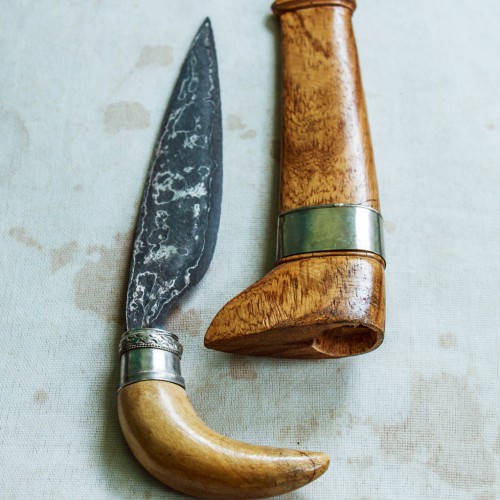

The badik is a Malaysian knife with a great degree of variance in its design. While all badik knives are characterized by their pistol grips and wood, ivory, or horn handles, the design of the blade varies.
Blades can be single or double edged. Straight and curved blades also exist. Many badik knives are pattern welded, but not all.
The badik operates as a side arm or everyday tool for the Malay people. It is believed that blacksmiths imbue the blades with supernatural forces during the forging process.
These forces can bring wearers good or bad luck.
4) Balato


Balato swords originate on the Nias Island near North Sumatra. The unique blade shape widens at the tip. Balato hilts are usually carved in the shape of the traditional lasara monster or other animals.
Common hilt materials include hardwood or brass.
5) Bangkung


The bangkung is a traditional short sword of the Filipino Sulu Archipelago. The 50 to 75 centimeter blade is designed for slashing maneuvers.
One of the most interesting features of the bangkung is its wooden cockatoo pommel. Very few bangkung blades survive today, making the sword highly collectible.
6) Barong
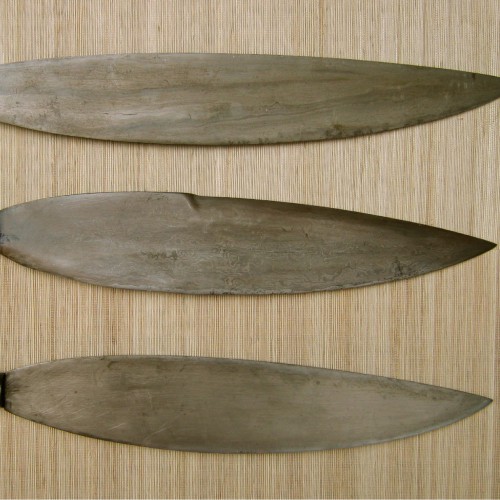

The Filipino barong is a single-edged sword with a distinct leaf shaped blade. The sword measures 20 t0 56 centimeters in total length and is a heavy weapon due to the blade design.
Sword hilts are traditionally crafted from ivory or horn. Soldiers carried the barong in World War II.
7) Batangas


The batangas knife is commonly known as a butterfly knife. This folding tool and weapon is thought to have originated in the Philippines in the Tagalog region.
Folding knives are useful for self defense and everyday tasks. The design of the batangas has been replicated by manufacturers worldwide.
Today, the batangas is banned in many countries. Filipino suppliers have been mass producing the batangas since the early 1900s.
8) Dahong Palay


The dahong palay is a single edged agricultural tool of the Philippines. This weapon measures 20-30 centimeters in length.
While originally intended for use in the fields, Filipino fighters used the dahong palay in colonial wars against the Spanish and during World War II.
9) Dha

_with_Scabbard_MET_36.25.1437ab_002Jun2015.jpg)
“Dha” refers to a variety of swords in Myanmar, Thailand, Laos, Cambodia, and Vietnam. While shapes and lengths may vary, dha swords are characterized by their long and slightly curved blades, lack of guards, and long hilts.
The overall design of the dha is similar to the Japanese katana.
The origins of the dha are murky, but many experts believe it was originally crafted in China.
10) Golok/Gulok
_with_Sheath_MET_36.25.822ab_004june2014.jpg)
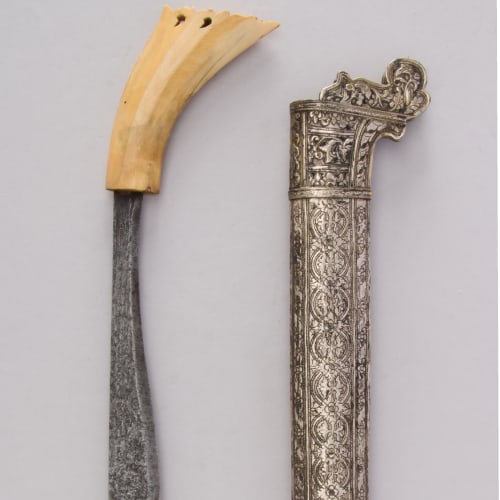
The golok or gulak is a Malay and Filipino weapon that is similar to a machete. Ranging in length from 25 to 50 centimeters, the golok is a versatile agricultural tool and battle weapon.
Goloks are traditionally forged with softer carbon steel than other weapons, which made them easier to sharpen on the battlefield.
11) Kampilan

_MET_36.25.1495_001Jun2015.jpg)
The kampilan is a sword with a single-edged blade that widens at the tip. This Filipino sword was historically used for headhunting rituals and in battles with the Spanish. Warriors wielded kampilans in the Battle of Mactan against Ferdinand Magellan.
Kampilan swords average 90 to 100 centimeters in length and have Damascus or pattern welded blades. The length of the blade is balanced by a substantial hilt. Pommels are shaped like animals such as cockatoos, lizards, and crocodiles.
12) Karambit

_with_Sheath_MET_36.25.855ab_008july2014.jpg)
The karambit is a claw-shaped knife of western Sumatra. The design of the knife is based on a tiger’s claws.
Originally, karambits were used by farmers as agricultural tools. It earned its reputation as a “peasant’s weapon” because of its agricultural origins.
Today, the karambit is utilized in martial arts.
13) Kris/Keris

The kris or keris is an Indonesian and Filipino asymmetrical dagger. This weapon has a long and mythical history. Like other weapons, the kris is thought to absorb magic powers during the forging process.
A kris is believed to give its wearer good or bad luck depending on a few factors. Older swords are widely preferred to those newly forged. The metals used in the blade should match the personality of the owner. Meteoric metals are considered more powerful and useful when combined with earth metals.
The shape of the blade matters too. The kris is characterized by its wavy and asymmetrical design. Blades can only contain an odd number of waves, with 13 being a desirable amount.
The kris is a national symbol of Indonesia.
14) Klewang


The klewang is a traditional sword of Indonesia and Malaysia. After its use in the Aceh War with the Dutch in the 19th century, the klewang was adopted by the Dutch Army. The Royal Netherlands Army continues to wield the klewang in ceremonial events.
The length of this sword varies from 38 to 76 centimeters. Blades are single-edged.
15) Kujang

.jpg)
The kujang is a pattern welded knife of the Javanese people. The curved knife is thought to have originated in the 8th to 9th centuries. A unique feature of the kujang’s design is the series of holes running the length of the blade.
This weapon is widely used as a talisman. People groups of Indonesia believe that blacksmiths imbue magic and luck into these and other blades.
16) Mandau


The mandau is used by the Dayak people of Borneo as a ceremonial item and an everyday tool. The blade features tempered metals. Mandau hilts are typically crafted from wood, horn, or bone.
Historically, the Dayak people used the mandau for headhunting practices. Since the outlaw of headhunting, the mandau has been relegated to chores and ceremonies.
17) Pandat
_with_Scabbard_MET_36.25.1401a_b_001_Apr2017.jpg)
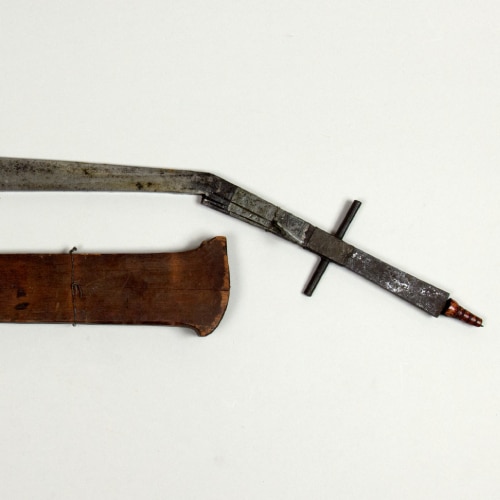
The Dayak people of northwest Borneo have historically used the pandat sword in battle. This short, single edged weapon features a bent blade that is ideal for downward cutting maneuvers.
18) Rencong


The rencong is a dagger or knife that is used by the Acehnese people of Indonesia. The blade measures 10 to 50 centimeters on average while the hilt has a pistol shape.
While commonly used for fighting and martial arts, the rencong is also used for symbolic and ceremonial purposes.
19) Si Euli


The si euli is a knife used by the Nias people of North Sumatra. The knife design varies depending on its intended use as a war, luxury, or everyday weapon.
Si euli blades are characterized by their curved hilts. This weapon is rare and highly collectible.
20) Sikin Panyang
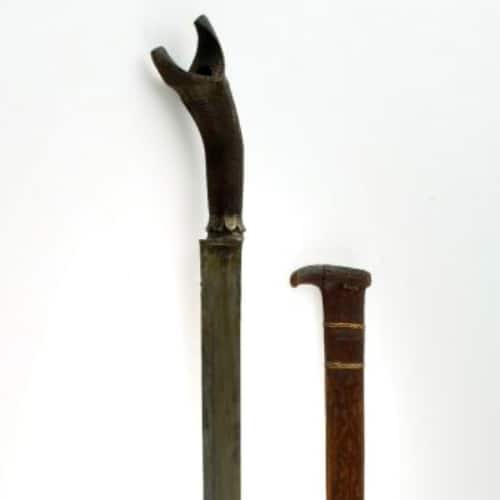

The sikin panyang sword is the most common weapon of North Sumatra. The blade was utilized in the Aceh War against the Dutch beginning in the 1870s.
This single edged, straight sword features a pattern welded blade and a uniquely “Y” shaped hilt.
A gold crown detail is featured on many sikin panyang blades swords at the base of the blade. This crown possesses anywhere from 1 to 4 tiers which signify the rank of the wielder.
This sword ranges in average length from 70-79 centimeters.