
Types of Glass Used in Glassblowing, Lampworking & Bead Making

Glassblowing and lampworking are two of the most common glassworking techniques employed by glass artisans today. Glassblowers work on a large scale, using ovens, blow pipes, and enough glass to make vessels, sculptures, and other decorative items.
Lampworking is generally done on a smaller scale using colorful glass and torches to make delicate beads. Regardless of which technique an artist chooses to create glass items, the material used to make them is important.
Glass artists depend on several types of glass to create beautiful and durable finished products. Glass has been developed and perfected to ensure versatility as an artistic medium, and each type of glass has its own benefits.
Where to Buy Glassblowing Glass & Lampworking Glass? We Recommend:

- Devardi Glass COE 90 Premium Assorted Fusing Pack. 8 ounces. (Pictures are samples and do not...
- 2 ounces of random beautiful sheet glass from over 4000 colors, similar to pictures. 1 ounce of...
- 1 ounce of Premium Millefiori. 3 ounces random glass rods from large assortment. 1 ounce assorted...
General Glassblowing & Lampworking Glass


Standard glass is made by melting sand or quartz. Glass without additives is called quartz glass and has a very high melting point, making it expensive and difficult to work with. Additives called fluxes are used to lower the melting point of glass. Common fluxes are soda ash, potash, and lime.
While helpful in creating more workable glass, fluxes can make glass unstable and prone to forming unwanted crystals. Stabilizers like limestone and zinc oxide are added to glass to counteract the negative side effects of fluxes.
The two most common types of glass used in glassworking today are borosilicate, or “hard” glass and soda-lime or “soft” glass. Each are readily available at online retailers and have their own pros and cons when used for glassblowing, lampworking and other glass art techniques.
1) Borosilicate Glass (“Hard” Glass)

Borosilicate glass is made of silica with at least 5% boric acid in its overall composition. It has a high melting point and is very resistant to temperature changes and chemical corrosion. Borosilicate glass melts at around 820 degrees Celsius and is easily worked at 1,200 degrees Celsius.
Borosilicate glass is a moderately priced glass due to its method of production and its durability. It is commonly used to make laboratory ware, bakeware, microscopes, and telescopes when used commercially. Lampworking artists use borosilicate glass for a variety of projects such as jewelry, marbles, sculptures, and decorative lighting.

- 10 Devardi Glass Clear COE 33 Boro Tubes.
- Lengths - 11 to 12 inches, 8mm OD x 1.5mm Wall, 12mm x 1.5mm, 16mm x 1.8mm
- Must use propane/oxygen Torch. Will not melt with propane only torch. Not to be mixed with COE...
2) Soda-lime Glass (“Soft” Glass)
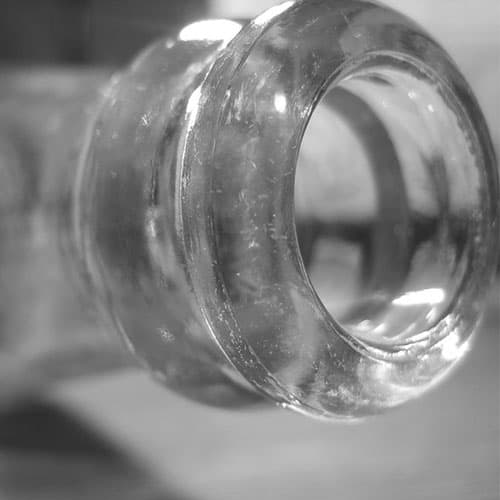
The most common and inexpensive glass used in glass art is soda-lime glass, or soft glass. Made from 60%-75% silica, 12%-18% soda, and 5%-12% lime, this glass is chemically stable, hard, and workable. It also has the ability to be re-melted, making it very versatile in the studio.
The softening range for soda-lime glass is 696 degrees Celsius and the working range for this type of glass is 1,000 degrees Celsius. These relatively low temperatures make soda-lime glass a great option for lampworkers using torches. Soda-lime glass can be used for almost any project, and can be found at glass retailers for affordable prices.
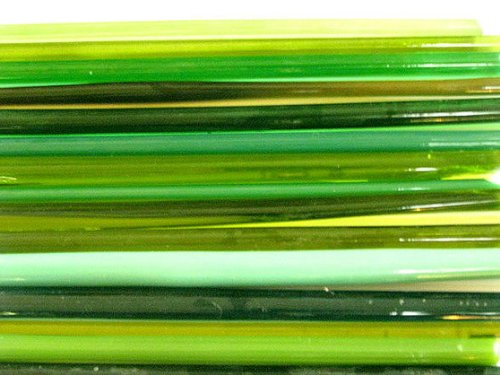
- Devardi Glass is a high quality handmade glass from India. May be inconsistent in thickness or shape...
- Random selection of rods, Transparents, Semi-Transparents, Opaques.
- Sizes of the rods vary from 6-10 mm thick and 8-12 inches long. 1 lb (12-14 rods)
Specific Glassblowing and Lampworking Glass
Within the two broad categories of glass commonly used by glass artists, there are several varieties of glass that are more specific depending on the preferences and specializations of the artist. These variations are achieved through chemical and physical alterations, as explained further in each section.
1) Clear & Colored Glass Varieties

Both borosilicate and soda-lime glass can come in clear or colorful variations. Clear glass has a simple composition and is preferred for scientific glassware, household drinkware, and vases.
Colored glass is made by adding a range of chemical compounds such as iron oxides, manganese oxides, carbon oxides, copper, and tin. The addition of these elements creates a multitude of colors from black to white and everything in between.

- 1 lb Devardi Glass Boro Rods, Mixed Colors. COE 33 Random selection of colors shown
- Glass rods range from 10 - 12"
- Must use propane/oxygen Torch. Will not melt with propane only torch. Not to be mixed with COE...
2) Dichroic Glass

Another variation of borosilicate and soda-lime glass is dichroic glass, which is commonly used for beads, jewelry-making, and vessels. This glass shows up as two different colors depending on the lighting. Color changing glass has been around since the 4th century.
Today, dichroic glass is made by layering metals such as titanium, aluminum, and magnesium and vaporizing them in an electron beam in a vacuum chamber. Finished dichroic glass can be made of 30 to 50 layers of metals.

- Devardi Glass is a high quality handmade glass from India. May be inconsistent in thickness or shape...
- Random selection, from huge assortment. Similar to picture, but not exact ones. Pictures do NOT show...
- About 50% dichroic pieces, 50% fancy colored sheet glass pieces. Fusing, Slumping and Bead making.
3) Frit

Frit is a common material used in lampworking. Frit is created through physical alterations instead of the addition of certain chemicals. It is essentially just colorful, ground up glass.
Despite its simplicity, frit has important uses in creating decorative, multidimensional beads and jewelry elements. Frit comes in a variety of colors and is added to hot glass to make bright, unique swirls and spotted designs.

- Devardi Glass Rods COE 104, soft glass. Beautiful Mixed Frit - Frit Sampler
- 10 one ounce baggies - # 1 - #2 Frit (1/16 to 1/8 inch)
- Use with an all propane/Mapp torch, or propane/oxygen torch. Make beautiful glass beads, marbles and...
Working with Hard and Soft Glass (Video Tutorial)
While borosilicate glass is the most common type of glass used for flameworking and bead making, soft glass also has its uses. Because it is easily malleable, soft glass is a great addition to any project. Just make sure to work with it at a lower temperature than borosilicate.
If you are wondering how to incorporate both hard boro and soft glass into your next project, this video can serve as inspiration and provides some helpful instructions. Several types of soft glass are incorporated into one item. You can use the same techniques to create your favorite flameworking objects.
The artist in the video does a great job of showing all the steps of the process and we highly recommend watching the video all the way through before attempting similar projects on your own. We have also included written instructions and advice for your convenience.

In this tutorial, the flameworking artist creates a candy cane out of borosilicate glass and a piece of candy out of soft glass.
Begin by heating the ends of red and white boro rods. Once heated, lay a trail of red down one side of the white rod. Repeat on the other side as shown. Melt the colors together into one smooth piece. This will ensure a strong join between the white and red colors and will prevent the candy cane from breaking.
Marver as you melt the two colors together to create a smooth shape. Once the colors have blended together, begin turning the white rod to create the twisted pattern of a candy cane.
To ensure that the candy cane is even in thickness, continue to heat where needed and take breaks to marver.
Heat and bend the end of the rod into the shape of a cane. Carefully heat the end that is joined to the rest of the rod and clean up the end as needed once it is detached.
To make the candy piece or sweet, heat the end of a soft glass rod to clean it up. Turn the rod quickly to begin forming a blob at the end. Use a small mold to refine the shape into a perfect sphere.
Roll the ball you’ve just created in gold mica as shown in the tutorial. Then place the ball back into the flame to reheat.
Apply a clear glass “wrapper” all the way around the candy piece. To create the ends of the wrapper, apply some of the clear class to the end of the candy, flatten, and twist.
Heat and remove candy from the rest of the rod. Apply the other twisted wrapper end to the other side of the sweet to finish.
Hi there,
I’m not sure who exactly is receiving this comment, but I really appreciate the information in your article above.
I’m really impressed with the Devardi Art Glass line from India. I have communicated with someone at Devardi a while back, and they were very nice and understanding about my questions. I understand that they are a family business, and as such they don’t yet have all the Internet amenities they would like to have. I usually do my ordering from companies via telephone ordering, as an “old guy” it is much much easier for me to order my lampwork supplies via phone. Devardi has some awesome wonderful tools, devices, and glass! Do you know if they have been able to work in a telephone ordering system yet into their offerings? Thank you so much, I look forward to trying many Devardi products.
Thanks so much,
Bob Fusco (aka: Beady Bob)
This is great. Am only a scientific glassblower wishing to extend my hands beyond