

List of Famous Japanese Swords in History & Legend [Updated]
Japan has an extensive history of sword making and swordsmanship. The best known sword of Japan is the katana, but other types of swords are equally important to the history and culture of the country.
Swords feature in many of the Shinto myths and legends of Japan and even real historical swords are incorporated into legends. Japanese swords therefore cannot be categorized simply into historical and mythological groups, but are instead understood by both historical facts and Japanese legend.
Samurai swords of exceptional quality and history are considered Tenka Goken swords. Many of them are associated with mythological stories. Swords that are featured in Shinto myths and legends are called Totsuka no Tsurugi swords.
Finally, there are other historical and legendary swords of Japan that do not fit into the above categories. They are significant to Japanese history and culture in their own ways.
Below is a list of Japanese swords from history and legend organized into these groups. Further explanation of each group is included.


Tenka Goken Swords of Japan
The Tenka Goken, or “Five Greatest Swords Under Heaven” are some of Japan’s most famous swords. Crafted and wielded during important periods of Japanese history, surviving swords in this category have special designations. Some are national treasures, one is a holy relic, and one is considered imperial property.
While historical artifacts, these samurai swords are also seeped in legend. Many have connections to Shinto myths and stories passed down through generations.
1) Dojikiri Yasutsuna
(10th-12th centuries)
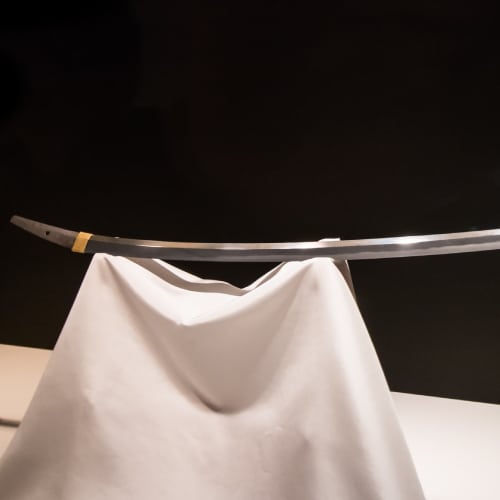

Dojikiri Yasutsuna is the first of the five Tenka Goken blades and is considered the most famous. The weapon was crafted by Hoki no Kuni Yasutsuna sometime in the 10th, 11th, or 12th centuries.
Legend surrounding Dojikiri Yasutsuna claims that Minamoto no Yorimitsu wielded the powerful sword and slayed a fearsome ogre of the Izu Province named Shuten-doji.
Dojikiri Yasutsuna is currently housed in the Tokyo National Museum as a National Treasure of Japan.
2) Onimaru Kunitsuna
(14th-16th centuries)

Onimaru Kunitsuna is a samurai blade crafted by Awataguchi Sakon no Shogen Kunitsuna sometime in the 1300s to 1500s. He made the sword for the Ashikaga clan of samurai, who dominated Japan during this time period.
Legend surrounding this sword tells of its ability to move on its own. Onimaru Kunitsuna was also allegedly used to kill an oni demon. This sword itself was nicknamed “demon” because of its uncanny and deadly abilities.
3) Mikazuki Munechika
(10th-12th centuries)


Mikazuki Munechika, or “crescent moon” featured a curved shape and was made by Sanjo Kokaji Munechika in the 10th to 12th centuries.
The sword is said to have been by blessed by Inani, the god or kami of foxes, fertility, and prosperity.
Mikazuki Munechika is currently being kept in the Tokyo National Museum and is considered a National Treasure of Japan.
4) Odenta Mitsuyo
(14th-16th centuries)


Odenta Mitsuyo is one of the famous swords of the Ashikaga clan of samurai. It was created by the bladesmith Miike Denta Mitsuyo and is one of his greatest swords.
The sword dates to the 14th, 15th, or 16th centuries, when the Ashikaga clan enjoyed the height of its power.
Odenta Mitsuyo was allegedly owned by the legendary general Maeda Toshiie is is said to have had healing powers.
5) Juzumaru Tsunetsugu
(12th-14th centuries)


Juzumaru Tsunetsugu dates to the 1100s-1300s. The sword maker Aeo Tsunetsugi is credited for crafting this blade. The name of this sword comes from its design. It was decorated with a type of Buddhist rosary called juzu.
Juzumaru Tsunetsugu belonged to a priest named Nichiren and was thought to contain magical properties.
This sword is unique to the other Tenka Goken swords because of its connection to Buddhism. The sword is housed in the Honkoji Temple and is a holy relic of Buddhism in Japan.
Totsuka no Tsurugi Swords of Japan
Swords that are part of Shinto myths and legends are called Totsuka no Tsurugi. These swords are usually wielded by powerful gods or goddesses to defeat enemies or establish features of Japan.
6) Ame no Ohabari


According to Shinto mythology, the sword named Ame no Ohabari was used by the Father kami Izanagi. Izanagi kills his newborn son Kagutsuchi with the sword and scatters the remains of the child across Japan, creating eight volcanos.
Ame no Ohabari was covered in the blood of Kagutsuchi and from his blood, new Shinto gods were birthed.
7) Ame no Murakumo


Ame no Murakumo is often compared to Excalibur in its significance to Japan. Just as the story of King Arthur and Excalibur are important to the culture of England, Ame no Murakumo is iconic in Shinto mythology.
The sword is considered a relic of Japan and is often called the “cloud gathering sword.” Ame no Murakumo was wielded by the kami of storms named Susanoo. He discovered the blade in the tail of the Great Serpent Orochi after killing the monster.
Susanoo gifted Ame no Murakumo to his sister in an attempt at reconciliation after a large argument. The sword is said to have been later passed down to Emperor Yamoto Takeru.
Ame no Murakumo was not a samurai sword. Instead, it bore a resemblance to a Roman gladius and measured about 32 inches in length.
8) Futsunomitama no Tsuragi


Futsunomitama no Tsuragi is another sword that features in Shinto mythology. It is said to have been wielded by Takemikazuchi, the kami of swords. He was one of the gods born from Ame no Ohabari.
This famous god was sent to Japan to bring peace to the Izumo Province. Takemikazuchi used Futsunomitama no Tsuragi to slay monsters in the province and restore the land.
Emperor Jimmu allegedly inherited the powerful sword later on. The spirit of Futsunomitama no Tsuragi is believed to be enshrine in the Isonokami Shrine.
Other Famous Swords of Japan
9) Kogitsunemaru
(8th-12th centuries)


The name Kogitsunemaru translates to “little fox” and the origin story of this sword helps explain this curious name. The sword was crafted by Sanjou Munechika in the Heian Period (8th-12th centuries).
According to Sanjou Munechika, a child avatar of Inani came to him while he was forging the blade and helped him complete the process. Inani was the kami of foxes, fertility, and prosperity.
10) Kogarasumaru
(8th century)


Kogarasumaru is a samurai sword created by Amakuni in the 8th century. It is one of the earliest known samurai swords in Japanese history.
The sword is part of the Imperial Collection due to its historical significance and is an heirloom of the Taira family.
11) Fudo Masamune
(13th-14th centuries)


Fudo Masamune was crafted by the famous swordsmith Masamune in the 13th or 14th century and bears his signature.
This artifact is not actually a sword, but rather a type of knife called a tanto. Measuring 10 inches long, this small blade is intricately decorated with tree root carvings and dragon imagery.
The Fudo Masamune is an heirloom of the Owari-Tokugawa family.