

List of American Sword Types of the 18th, 19th, and 20th Centuries [Updated]
When you think of historical swords, chances are you picture a medieval knight wielding his longsword or a samurai with a katana. So many countries around the world have thousands of years worth of sword history that you might not think of the United States when you consider the history of swords.
While America does not have a long history of swords like other countries, there are still several sword types you need to know if you want to understand the military and weapons history of the United States.
Although a relatively young country, the United States has had its fair share of wars and conflicts, and several types of swords were essential to combat during this events.
Below are five broad categories of American swords from the 18th century to the 20th century. Consider this article a jumping-off point for your research into swords of the United States.
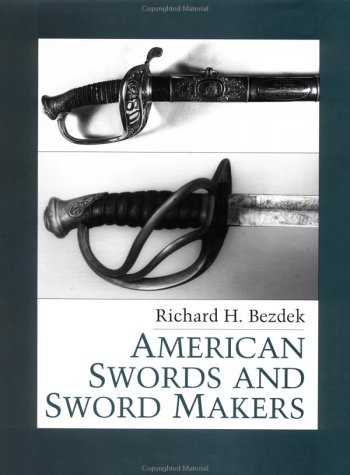
- Hardcover Book
1) Presentation Swords
(18th-20th centuries)

One of the most common American sword types sought after by collectors is the presentation sword. These swords were given to high ranking military officers in recognition of a heroic deed. Many presentation swords were awarded to wounded officers or given to the families of the deceased.
Presentation swords from the 19th century are most common, simply because that century is the height of sword use and manufacturing in the United States.
While Revolutionary leaders did wield European-made swords, the Colonies did have many swordsmiths before they became a country in the late 1700s. Even then, sword manufacturing lagged until after the War of 1812.
Presentation swords therefore come a variety of styles ranging from British to French to American.
2) Pre-Civil War Swords
(1790s-1850s)
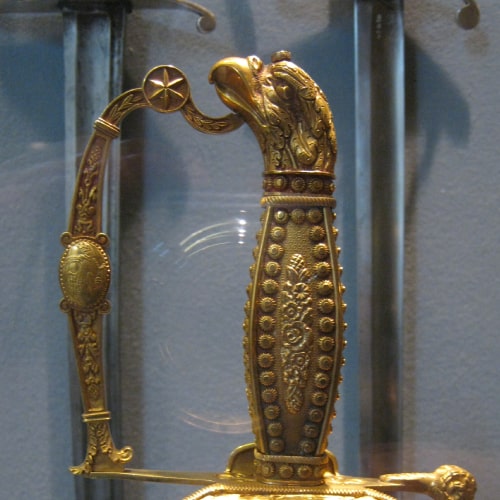
American swords can also be organized into pre-Civil War era weapons. Swords made and used in the United States prior to the Civil War are also highly varied in some ways, but share a few similar characteristics.
Most pre-Civil War swords feature ornate or at least very obvious hand guards attached to the sword hilt. Most hilts were made of brass and influenced by the styles of England and France.
Swordsmiths of this era (1790s to 1850s) decorated the hilts of their swords with ornate and highly detailed motifs of animals, flowers, and other natural imagery.
One of the most popular decorative details of pre-Civil War swords is the eagle head pommel. This detail is an instantly recognizable and obvious symbol of America and was popular from the 1790s to the 1840s.
Eagle head pommels can be found on militia swords dating after the American Revolution and on presentation swords of this era as well.
3) Civil War Swords
(1860s)
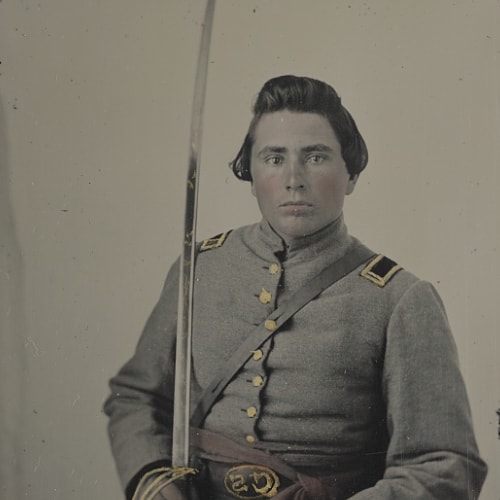

Swords of the Civil War era (1860s) are characterized by their brass hilts and leather grips. They share these characteristics with pre-Civil War era swords, but generally feature simpler designs.
Although firearms and heavy artillery were the most favored weapons of the Civil War, swords had their place in the militia. As relatively inexpensive weapons, foot soldiers in the both the North and South carried simple swords as backup and close range weapons.
Today, Civil War swords are some of the most popular swords among collectors and are often reproduced for personal collections and reenactments.
4) Cavalry Swords
(1800s-1910s)
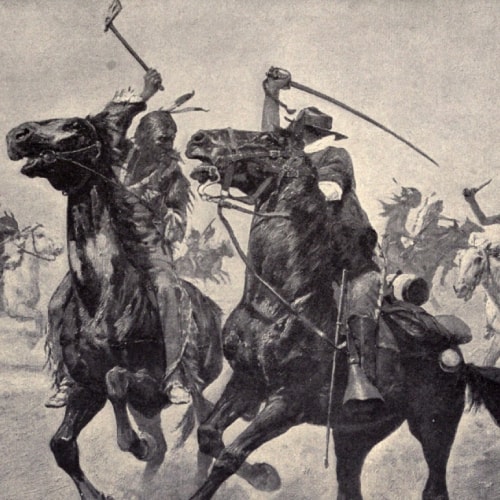

The United States cavalry had their own swords made especially for use on horseback. There were several iterations of the cavalry sword made throughout the 19th century and into the 20th century.
Each new version of the sword had its own strengths and weaknesses, and many are popular collector weapons today.
Cavalry swords are classified as sabers and feature a long and thin blade that was effective from the back of a horse. Early cavalry swords of the 1840s are considered “heavy” sabers. This classification is not necessarily due to their weight, but has to do instead with how they were used. These swords had “heavy” use among cavalry soldiers and are therefore classified as such.
In the case of the 1840s saber, however, weight was a factor that ultimately caused the cavalry to update its design. This specific sword was even nicknamed “wrist breaker” because of its heft.
Later designs of the cavalry saber included the 1860s light saber, which was just as heavy as its predecessor but featured a smaller, curved blade.
The last saber used by the American cavalry was introduced in 1913. This model was a well balanced and more modern upgrade that ended a century’s long tradition of sword making and use in the United States cavalry.
5) Navy Cutlass
(1790s-1940s)

While we likely do not think of swords when we think of today’s Navy, the United States Navy did rely on the cutlass for much of its early history. The cutlass was a shorter sword with a straight or curved blade.
This weapon could be used for cutting and thrusting and was the perfect size for use aboard ships. The Navy cutlass evolved from the earlier European falchion.
Like the cavalry sword, the Navy cutlass underwent much transformation between its debut in the 1790s and its discontinuation after World War II.
The earliest Navy cutlasses featured blades measuring around 29.5 inches. This short sword allowed sailors to fight at close range aboard the relatively confined decks of Navy ships.
Cutlasses of the early 1800s received upgrades to their length and style. Blades now measured around 32.5 inches. They were flat and featured angled tips similar to Bowie knives.
In the 1840s, the Navy upgraded their cutlasses again to be double edged, 21 inches long, and heavier than previous versions.
The final major change to Navy cutlasses occurred in the 1860s. New swords had only a single edge on their curved blades. This version of the cutlass remained in use through World War II.