

List of Historical Viking Helmet Types & Archaeology [Updated]
Many of us have wondered what the Vikings really looked like. While we see many interpretations in the media and even online, it can be difficult to form a clear picture of a Viking warrior.
The mixture of myths and facts found in different sources makes studying the true Vikings difficult. Everyone has an idea of what the Vikings must have looked like and acted like, but few agree on all of the details.

_(14597699920).jpg)
This is true not only of internet history buffs but also scholars who have dedicated their lives to the study of the Vikings and Viking Age Scandinavia (793-1066 AD).
As we will explore in this article, the use of archaeology and dating methods help us to determine what sorts of items and objects define the Vikings.
One of the rarest Viking artifacts is the helmet. Only a few fragments have been found, but these small pieces help us to understand not only what the Vikings may have looked like, but also how their fighting styles and personal identities may have changed over time.
This article explores the myths and facts surrounding Viking helmets. Consider it a companion article to read alongside our other post on Viking armor.
Viking Helmet Myths Debunked


The horned helmet is the most widespread Viking myth. Scholars have debated the existence and prevalence of horned helmets and most conclude that they were not a common helmet style.
Interestingly, the horned Viking helmet is not simply fantasy. Nordic sagas tell of certain Viking warriors with horns on their helmets. These warriors were likely the berserkers, the most feared Viking fighters who were also an elite group.
Horned helmets may also have been worn for cultic or ceremonial purposes.
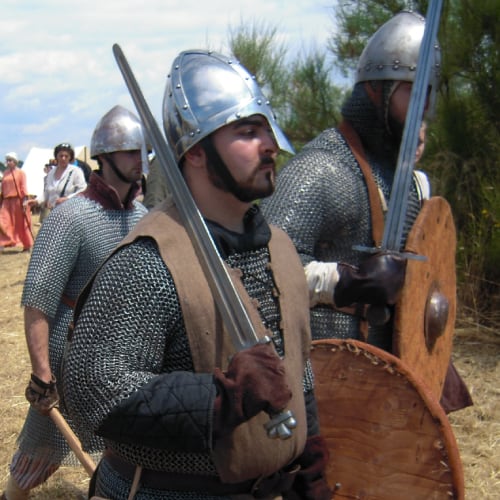

Regardless of who wore horned helmets, it is clear that this style did not exist for everyday wear. Common Viking warriors would have had much simpler and more functional head gear with the main purpose of protection.
While the horned helmet is distinctly “Viking” in its style, in reality, the Vikings likely wore the style of helmet that was popular across Europe at the time.
This style, the spangenhelm, is discussed in detail below.

.jpg)
While many myths exist surrounding the Vikings’ habits and appearance, archaeology and eyewitness accounts of the Vikings help us piece together an understanding that is closer to the truth.
Studying Viking Armor: Primary Sources, Archaeology & Fragments


One of the best ways to understand what the Vikings actually wore on their heads is by looking at primary sources from the Viking Age and Early Middle Ages.
Primary sources are letters, eyewitness accounts, illustrations, and other documents that date to the time period being studied. One of the best primary sources available to us from the end of the Viking Age is the Bayeux Tapestry. This giant embroidered cloth depicts events around the Norman Conquest of 1066.
The Norman period coincided with the end of the Viking Age and tells us much about what the Vikings might have worn towards the end of their influence.
The soldier depicted above wears a spangenhelm or nasal helmet. These closely related helmet styles were common in the 11th century and were worn by the Vikings as well.


Archaeological fragments of Viking Age helmets are other types of evidence used by experts to literally piece together the mystery of Viking head gear.
Several fragments of Viking-era helmets have been found in Scandinavia and England. These fragments are analyzed by experts and sometimes used in helmet reconstructions.
More information on these famous fragments is provided in the next section.

.jpg)
Helmet fragments are still useful even when they are not pieced back together. Professional armorers use fragments to inform the creation of reproduction helmets.
Reproductions are handy tools for understanding the general shape and design of Viking helmets. Because so few artifacts exist, reproduction helmets allow museums to educate the public without displaying actual historical examples.
Because they are crafted by people living today, reproductions are not perfect representations of real Viking artifacts. However, a well-constructed reproduction helmet can help people understand the basic structure and function of Viking armor.
Viking Helmet Styles & Artifacts
Viking helmet styles can be organized into three main periods of Scandinavian history. These include the centuries before, after, and during the Viking Age.
The following are some helmet fragments that represent each time period.
Vendel Period (540-790 AD)
The Swedish Vendel Period lasted from the 6th to 8th centuries between the Migration Period and the Viking Age.
This period is characterized by the use of copper alloy and the exploration of waterways between Russia. There are also a number of rich grave sites dating to the Vendel Period, such as those of Valsgärde.
Broe/Vendel XIV Helmet


The Broe helmet and the Vendel XIV helmet date to the Vendel Period. Both helmets are similar in their design, which scholars call “crested.”
These helmets feature eyebrow detail and face protection.


The Broe helmet in particular was discovered in 1904 on the Swedish island of Gotland. Experts believe the helmet dates to the 600s.
Valsgärde Helmet


The Valsgärde helmet fragments were discovered at the archaeological site of Valsgärde in Sweden. This location was an important center for religion and the meetings of ancient kings during the Vendel Period.
Archaeologists uncovered this helmet in 1920. Due to its elaborate design, scholars consider the Valsgärde helmet to be of royal origin.
Early Middle Ages (476-1000 AD)
The early Middle Ages coincided with the Viking Age. Scandinavian Vikings adopted the standard helmet styles of the rest of Europe.
Due to their simple form and solid protection, the two main medieval helmet styles described here served Vikings well.
Spangenhelm
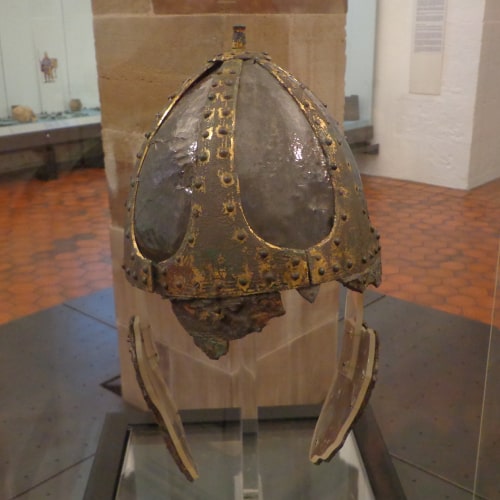
.JPG)
The spangenhelm was a simple conical helmet made up of “spangen” or bands of metal. These connected the main helmet plates together.
The spangenhelm originated in Central Asia, was popularized by Eastern Europeans, and was adopted by the rest of Europe between the 6th and 9th centuries.
While depicted in artwork from later centuries, the spangenhelm’s popularity tapered off in the 800s.


Some spangenhelm helmets featured simple nasal protectors, like in the image shown here. Others had cheek flaps made of leather or metal. These served to protect the sides of the face and secure the helmet in place.
Spangenhelms may also have featured chain mail to protect the neck.
Nasal Helmet


The nasal helmet is closely related to the earlier spangenhelm, but was crafted from a single sheet of metal instead of metal strips and plates.
The defining feature of the nasal helmet is its simple nose protector piece.
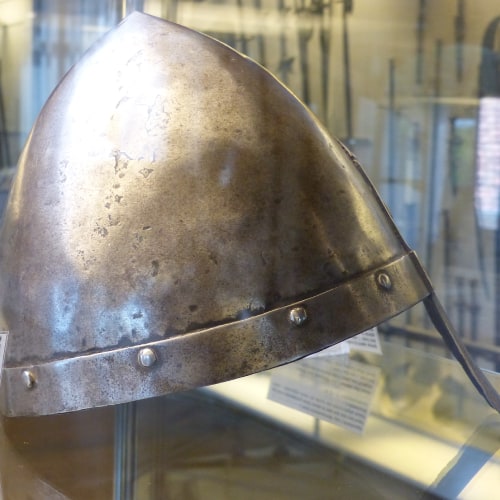

Nasal helmets were adopted in the late 800s and worn by major armies by 1066. This style of helmet appears on the famous Bayeux Tapestry, which shows the Norman Conquest.
Because of its adoption by warriors across Europe, it is concluded that Vikings used this style of helmet as well. The solid construction of the nasal helm would have provided protection from the blows of Viking axes and other weapons.
Viking Age 793-1066 AD
The Viking Age proper lasted from 793 to 1066. This time period is characterized by the exploration of the Vikings and their settlement in areas like England, Scotland, and mainland Europe.
The helmets of this period are distinctly “Viking” in their reconstructed appearances. Because no complete helmets exist from the Viking Age, reconstructions of fragments help us understand what the helmets may have looked like.
Because of the wide distribution of Vikings across northern Europe during the Viking Age, fragments have been uncovered in Scandinavia and Britain.
Gjermundbu Helmet


The Gjermundbu helmet is the most complete Viking helmet in the world. This artifact is extremely important to our understanding of the Vikings and their armor.
Archaeologists discovered this helmet in Norway in 1943 on the farm of Gjermundbu. It consisted of nine fragments that were pieced back together into the helmet shown here.
The Gjermundbu has a distinctive and slightly frightening mask detail. This frame around the eyes would have made a warrior anonymous.
This helmet resides in the Museum of Cultural History at the University of Oslo.
Tjele Helmet


The Tjele helmet fragment is another famous piece of Viking archaeology. It was uncovered in Denmark in 1830 and was largely ignored for many decades due to misidentification.
A museum worker later correctly identified it as a helmet fragment. The Tjele fragment dates to between 950 and 970. It is made of iron and bronze. Experts believe it is part of the eyebrow and nose parts of a typical Viking Age helmet.
Yarm Helmet


The Yarm helmet fragments are named for their discovery in Yarm, England. Workers uncovered the fragments in the 1950s while excavating and experts identified them as helmet pieces.
The Yarm helmet is the second near-complete Viking helmet to be discovered. It is the first to be found in Britain. The helmet dates to the 10th century.
This fascinating artifact is on display in the Preston Park Museum in Stockton, England.