
List of Middle Eastern & Islamic Blades from Ancient Times to the Present
Swords and daggers are two of the most widespread weapons in world history. The Middle East is one geographic area where the sword has been especially influential to the history and culture of its peoples.
Experts distinguish “Middle Eastern” blades by their shared history and the influence of the Islamic faith on their design. The swords and daggers listed in this article are characteristic of areas that have a long history of Islam as the major religion.
The following swords and daggers developed during the distinct but oftentimes overlapping periods of Mamluk, Ottoman, and Mughal influences.


Middle Eastern and Islamic swords and daggers possess unique characteristics that set them apart from other blades.
While not all blades will have the same design techniques, many possess Damascus steel blades, etching, gilding, inlay, and jewel settings.
Gold and silver are common materials found on Middle Eastern hilts and scabbards. Common patterns include flowers, animals, and Islamic iconography.
Of course, the most decorative swords and daggers were typically worn and used by the elite of society. It is important to remember that while most of the photos included in this article are of highly decorative blades, most of the swords crafted and used in the Middle East both historically and today are much simpler in design.
1) Acinaces

_mit_gerader_Griffstange,_Rozb%C3%B3rz.jpg)
The first blade on our list dates to the 1st century BC. The acinaces originated in the greater Mediterranean region and was used by the Medes, Persians, and Caspians.
This dagger measured an average of 40-60 centimeters or 14-18 inches and was double edged. Its lobed guard is similar in design and intent as the European bollock dagger of the Middle Ages.
2) Shamshir

_with_Scabbard_MET_DP164593.jpg)
The shamshir is one of several types of swords in the “scimitar” sword family. While the scimitar is the most well-known sword of Middle Eastern origins, it is actually not a single type of sword.
All scimitars do possess a few shared characteristics. They are full-sized swords that have curved blades. The curve of the blade varies from type to type.
The shamshir is a Persian sword with a very distinct blade curve. It developed into its true form in the 12th century from earlier sword styles. The shamshir took on its current form by the 16th century.
Bladesmiths traditionally crafted the shamshir using Damascus or pattern welded steel, but this is not a necessary feature for characterization.
3) Kilij

_with_Scabbard_MET_DP163320.jpg)
The kilij is another type of scimitar with Turkish associations. The kilij is a single handed, single edged sword that was first developed in the medieval period.
The curved blade was shortened in the 18th century and adopted by European militaries. Britain and France especially preferred the kilij for their cavalries.
The kilij pictured above has an elaborate design featuring inscriptions and large stones. These were thought to ward off the evil eye.
4) Pulwar

_MET_36.25.1526_001_Mar2017.jpg)
The pulwar is an Afghan version of the scimitar. This sword was originally based on Central Asian designs. Most surviving pulwars date the 1800s.
This sword is characterized by its curved blade and unique hilt. The hilt features two quillions that point towards the tip of the blade. The hilt is also uniquely made of iron with a cup-shaped or rounded pommel.
Compared to other Middle Eastern and Islamic swords, the pulwar was the most customizable. Many featured blades from Persia, while the hilt was crafted in Afghanistan.
The pulwar is most similar to the talwar (described next) but with more dramatic fullering.
5) Talwar

_with_Scabbard_MET_DP165528.jpg)
The talwar is an Indian scimitar that was developed under Islamic influence. While curved like any other scimitar, the talwar does have a straighter blade overall.
This sword is characterized by its disc-shaped pommel and short cross guard. Pommels sometimes have a point or a ball in addition to the disc. The cross guards generally have wider ends.
6) Yataghan

The yataghan was common in Turkey between 1700 and 1800 but dates as far back as the early 1500s. This blade is considered a short sword or long dagger.
This blade features a single edge and measures 60-80 centimeters. It has what experts call a “recurved” blade shape and lacks a guard. Most blades consist of hard and soft steels.
Janissaries, who were the sultan’s private soldiers, utilized simple forms of the yataghan for battle and everyday use. More ornate versions were crafted for the sultan himself.
The yataghan pictured above is one of the earliest surviving examples made for the Ottoman sultan. It is richly decorated with a gold foliage pattern on the upper blade and hilt.
7) Khanjar

_MET_36.25.675_002june2014.jpg)
The khanjar is a national symbol of Oman, but has spread to many countries in the Middle Eastern region. The dagger is distinctly J-shaped.
Khanjar dagger hilts crafted for common people are traditionally made from brass or copper. More ornate versions feature gold or silver. The khanjar pictured above has an ornately carved ivory hilt inlayed with gemstones.
In modern times, the khanjar is only used for ceremonial purposes like weddings and parades.
8) Kard
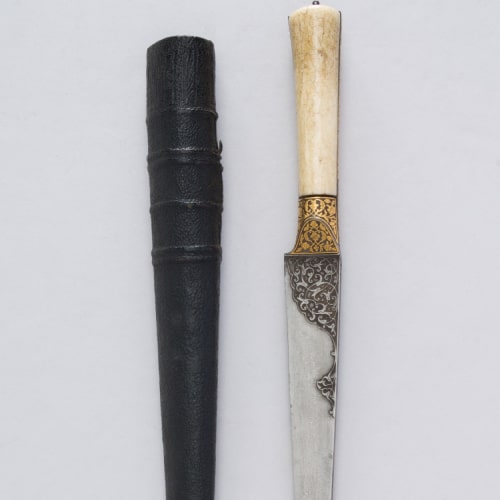
The kard is a Persian dagger that was most common during the 19th century. The straight and single-edged blade is designed to be worn on the left side of a belt.
The dagger’s tang is the same width as the blade. Decorate hilts and blade etchings are common features of the kard.
The example shown above has an ivory and gold hilt with subtle yet elegant etching on the blade.