

List of the Most Famous Female Samurai in History [Updated]
Samurai are some of the most recognizable warriors in world history. This elite military class was similar to the knights of Europe and followed a strict code of honor. While most samurai were men, high ranking women and the wives of the samurai also learned marital arts and tactics and were immersed in samurai culture.
Female samurai learned slightly different fighting skills than their male counterparts and were called onna-bugeisha, which translates to “woman warrior.” While samurai men fought with the katana, wakizashi, and other weapons, onna-bugeisha learned to use the naginata as their main weapon. The naginata was a pole arm with a curved blade that allowed women to keep some distance between themselves and their enemy. The length of the weapon also helped balance out the shorter stature of most onna-bugeisha.
Like their male counterparts, onna-bugeisha were skilled with more than one weapon. While the naginata was their primary weapon, onna-bugeisha also learned archery. Later, some onna-bugeisha would excel at shooting.
Onna-bugeisha existed in Japan since the 12th century, but the height of their influence occurred during the Warring States period, when male samurai dominated Japan. During this time period, female fighters were relatively common. An archaeological study of the Battle of Senbon Matsubaru showed that 35 out of 105 soldiers were women. Other battles reveal similar numbers.
The samurai and onna-bugeisha lost their influence by the mid 19th century with the 1868 Meiji Restoration, but their stories continue to fascinate today. The following are some of the most famous and influential female samurai, or onna-bugeisha in Japanese history.


1) Tomoe Gozen
(1157-1247)


Tomoe Gozen is the most famous onna-bugeisha in Japanese history and is widely considered to be Japan’s first true military general.
She participated in the Genpai War, in which the Minamoto and Taira clans battled for supremacy. While Tomoe Gozen proved her worth many times over during the war, she is most famous for defeating the Musashi clan’s leader in the Battle of Awazu.
Tomoe Gozen was one of the only onna-bugeisha in the Genpai War to engage in defensive combat.
Intelligent, brave, and beautiful, Tomoe Gozen also excelled at archery and horseback riding.
2) Hangaku Gozen
(12th-13th centuries)


Hangaku Gozen was another onna-bugeisha who participated in the Genpai War. She was a member of the defeated Taira clan. Later, in 12o1, Hangaku Gozen led 3,000 soldiers in an attempt to overthrow the shogunate.
After being wounded in battle, Hangaku Gozen was taken captive by enemy soldiers and was sentenced to death. Luckily, one of the soldiers fell in love with her and saved her from her fate.
Hangaku Gozen and the soldier married and had at least one child together. She lived out the rest of her life peacefully.
Hangaku Gozen is said to have been both fearless and beautiful. Like other onna-bugeisha, she excelled with the naginata in battle.
3) Hōjō Masako
(1156-1225)

.jpg)
Hōjō Masako was born into the Hōjō clan in the 12th century. She was the wife of Minamoto no Yoritomo, the first shogun of the Kamakura period.
Masako proved adept at politics and used her position as the wife of the shogun, as well as her intelligence to shape the careers of her two sons. Thanks to Hōjō Masako, her sons Minamoto no Yoriie and Minamoto no Sanetomo became the second and third shoguns of Japan despite political intrigue and plots throughout their young lives.
After securing the futures of her sons, Hōjō Masako retired to a quiet and peaceful life as a Buddhist nun. She is remembered as the “nun shogun.”
4) Nakano Takeko
(1847-1868)


Jumping ahead several centuries, the next onna-bugeisha on our list is Nakano Takeko. She lived at the end of the samurai reign, and is remembered as one of the last true onna-bugeisha in Japanese history.
Nakano Takeko was the daughter of an Aizu official and proved adept at martial arts at a young age. She was extremely skilled with the naginata and used it as her primary weapon during the Battle of Aizu.
Nakano Takeko was the leader of a corp of female samurai in this battle against the emperor.
She fought with bravery and skill, but suffered a gunshot wound to the chest. She died at only 21 years old.
The samurai tradition met its end the same year of Takeko’s death in 1868. The Meiji Restoration reorganized Japan and both male samurai and onna-bugeisha lost their influence.
5) Yamamoto Yaeko
(1845-1932)
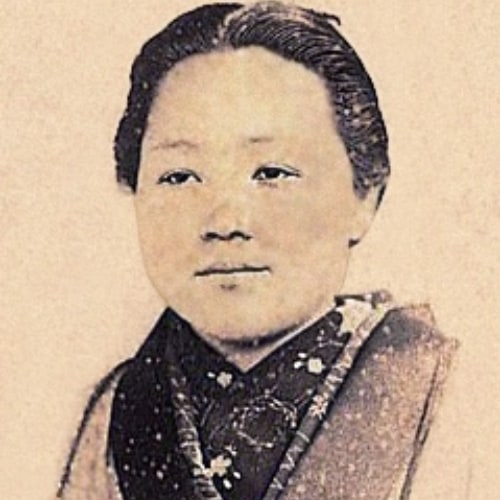

Yamamoto Yaeko was born in 1845, only two short decades before the samurai class was disbanded. Yaeko learned how to shoot from a young age and proved to have natural skill.
She was a gunner during the Boshin War and earned the nickname “Bakumatsu Joan of Arc.” At the time, female gunners were relatively rare, so this was a huge accomplishment.
Yamamoto Yaeko also fought against the Meiji government in the Battle of Aizu and worked as a nurse during the Sino-Japanese War.
After the downfall of the shogunate and the start of the Meiji Restoration of 1868, Yamamoto Yaeko moved to Kyoto. There she met and married a Japanese Christian missionary and converted to Christianity.
Yamamoto Yaeko founded Doshisha University in Kyoto. She is remembered for her many brave and noble contributions to her country.
Hi, not sure why this article refers to “Nakano Take K o” then in paragraph her name is spelled “Nakano Take D o” not sure if this is a mistake. Apart from this great article.
Hi Ryan,
Thank you for your comment and for pointing that out! It was a typo and has now been corrected. Happy to hear you enjoyed the article!
Thank you. I never knew.