
List of African Swords from Ancient Egypt to the Present Day
Most of us recognize historical swords like the European longsword or Japanese katana. These swords are commonly featured in movies and tv shows. Less well-understood but no less important to the history of blades are African swords and daggers.
Blades of the African continent are extremely diverse in their design and uses. Saharan and sub-Saharan cultures utilized bladed weapons for various purposes. Thanks to the nomadic nature of African blacksmithing, similar forging techniques can be seen across the continent.
African societies revered blacksmiths as craftsmen, magicians, and healers.
Swords of Africa are categorized based on their uses. Ritualistic and ceremonial swords lacked sharpened edges but were highly decorated with precious materials and symbols. They served as objects of status for Asantehene chiefs and other important figures.
War swords were simpler and designed for effective fighting. Swords could be designed for cutting, thrusting, or both.


To gain a more complete understanding of the global history of swords, let’s take a look at some of the most significant and distinctive blades of historical and modern-day Africa.
Many of the swords listed here have long been a part of African societies. Others are more modern and are still used today. While this article aims to provide a solid look at African swords, it is by no means a complete list.
Consider this a summary of swords from diverse African regions or a starting point into further African sword research. The following swords are listed in roughly chronological order. Keep in mind that swords have long and overlapping histories and that many are still used today.
1) Khopesh


One of the most ancient swords of Africa is the Egyptian khopesh. This sickle-shaped weapon developed from the battle axe.
It was used by pharaohs and their militaries from 3000 BC to 1300 BC. One of the earliest depictions of the khopesh shoes its use by King Eannaum of Lagash in Mesopotamia.
The khopesh made its way from Mesopotamia to Egypt and is pictured in many examples of artwork. Two of the blades were found with King Tut.
Ceremonial versions of the khopesh lacked sharpened edges but displayed the power and prestige of their wielders. The average khopesh measured 50 to 60 centimeters or 20 to 24 inches in length.
2) Mameluke


The mameluke sword is similar to the Middle Eastern scimitar. It originated in Mamluk Egypt, which was controlled by the Ottoman Empire.
Although the mameluke is an African sword, its design was adopted by Western military groups like the United States Marines and British Army. While the designs of these swords were inspired by the traditional mameluke, few were actually crafted in Africa.
3) Nimcha

_with_Scabbard_MET_DP164599.jpg)
The nimcha is a North African sword mostly used in Morocco, Algeria, and Tunisia. It was popular in the 16th to 18th centuries with soldiers on land and sea. The nimcha was a favorite weapon of Barbary pirates.
This sword type featured a single edged blade. Many blades were imported from Europe and fitted with African hilts.
Two of the distinctive features of this weapon are its forward facing cross hilt and wooden pistol grip.
4) Flyssa

_with_sheath_MET_36.25.785ab_002june2014.jpg)
The flyssa is a traditional sword used by the Berber people of Algeria. Most surviving artifacts date to the 19th century but the sword was used earlier as well.
Flyssa blades vary widely in length from the size of a dagger to a full sword. Blade lengths range from 30 to 97 centimeters (12 to 28 inches).
This sword’s single edged blade narrows to a sharp point and can feature chiseled designs along its length. The hilt lacks a guard but does feature distinct animal carvings that are meant to protect the wielder from the Evil Eye.
5) Koummya


The koummya dagger was historically used by Berber and Arabic peoples of Morocco. The curved and double-edged blade tapers to an obvious point.
This small but useful weapon features a distinctive flared pommel in the shape of a peacock’s tail.
6) Takouba
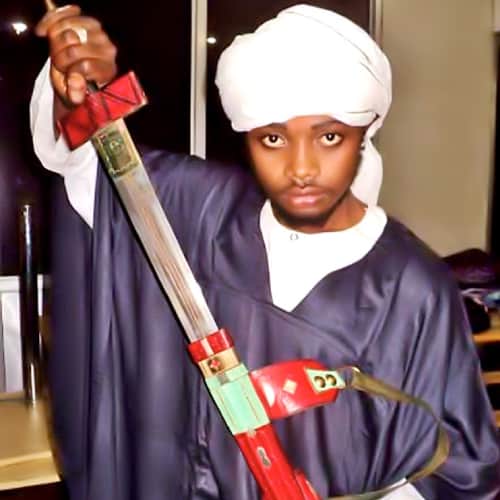

The takouba or takoba sword is historically significant to several people groups in the Sahel region of Africa between the Sahara Desert and the savanna of Sudan. The Taureg people in particular have a long history of making and wielding the takouba.
This group historically acted as highwaymen in the Sahara desert. They levied tolls from trans-Saharan caravans and used the takouba for self-defense and war.
Interestingly, takouba swords are crafted by a separate group of metalsmiths. The Taureg people refrain from touching iron, and so believe bladesmiths who work with the material to have magical powers.
Takouba hilts are completely covered with leather, brass, copper, silver, and other non-iron materials to prevent direct contact with the iron.
Blades are long, straight, and double-edged. They measure between 74 and 84 centimeters and resemble the kaskara sword described below.
While the takouba resembles European swords, the design is considered to be of African origin. Historians have speculated whether the sword is based on European or Arab influences, but most now agree that the takouba design is completely independent from those of other continents.
7) Kaskara


The kaskara is found in Sudan, Chad, and Eritrea. Its design may be based on medieval Arabic swords.
Kaskara blades average a yard in length and are double-edged. Many feature Islamic inscriptions. Hilts have simple cross-guards with ornate grips.
Scholars categorize kaskara swords based on grip design. Common motifs include diamonds, stars, dotted crosses, and silver filigree.
Most kaskara swords date between the 14th and 19th centuries and were owned by men of all social positions. The sword continues to be popular today with pastoralists as a means of self-defense.
8) Shotel


One of the most dramatic African swords is the shotel. This heavily curved weapon originates from Northern Ethiopia.
The double-edged blade measures an average of 40 inches. Hilts usually are crafted from wood and horn.
The shotel dates as far back as the 10th century BC and was used by elite warriors. The shape of the shotel made it ideal for hacking at mounted or foot soldiers. Mounted fighters could be pulled down from their horses using the hooked blade.
9) Ol Alem


The ol alem or Masai seme is a double-edged blade from Kenya and Tanzania. The blade has a unique design that widens towards the tip.
Traditionally, the use of the ol alem is reserved for men only. Boys are initiated into manhood between the ages of 15 and 21 and are then allowed to wield this blade.
10) Billao


The Somali billao is a short sword with a double-edged and leaf shaped blade. This weapon measures an average of 17 to 25 inches.
Many billao swords have a distinctive hilt made of buffalo horn and other natural materials. While the billao continues to be an important object in Somalia, it had widespread use in the Dervish Resistance of 1896 to 1920.
11) Ida


The ida sword is a traditional weapon of the West African Yoruba people. Most Yoruba live in present day Nigeria, Benin, and Togo. Blacksmithing is an important craft in Yoruba society. The Yoruba’s earliest use of iron dates before 800 AD.
Ida blades highly varied depending on their intended uses. While all blades are long, they can be single or double edged and narrow or wide.
It was common practice to coat ida blades with pepper or poison to make their cuts more lethal. Non-military uses of the ida include hunting and everyday chores.
12) Akrafena

.jpg)
The akrafena sword is an important symbol of the Ashanti or Akan ethnic group of Ghana. It is a national symbol and its use in martial arts is considered a national sport.
The akrafena was traditionally wielded in battle. Its design and use varies depending on the rank of its wielder. Most akrafena blades feature punched patterns.
13) Ikul


Ikul short swords are traditional weapons of the Kuba people of the Congo. The wide, leaf shaped blade is both beautiful and highly functional for slashing.
Blades measure an average of 35 centimeters. The distinctive metal design of this short sword is balanced with a wooden handle.
14) Ikakalaka


Blacksmithing is an important occupation among the Ekanda people of the Congo region. The ikakalaka blade is a masterpiece of these craftsmen.
Ikakalaka knives feature ornamentation because of their use in ceremonies. Both men and women could wield an ikakalaka in ceremonies honoring the birth of a first child.
Examples of this blade found in museums usually date to the 1800s or early 1900s.
Grand swords.
I remember the ikakalaka one used by Killmonger on The Black Panther film done by the MCU.
The Mamlukes were originally Caucasian slaves from Eastern Europe who overthrew their Egyptian masters and ruled that country for 300 years.
One could only become a full-fledged Mamluke warrior if they were able to behead an enemy with a single blow of their sword. They lost power because they were too reluctant to give up their swords and fight with gunpowder.