

Lampworking vs. Glassblowing – What’s the Difference? (updated)
Glassworking as a general artform has existed for thousands of years, and many of the traditional techniques and processes are still in practice today. Two of the main forms of glassworking are glassblowing and lampworking. For those of us outside the world of glassworking, the two artforms may seem rather similar.
In reality, there are subtle distinctions between the histories of lampworking and glassblowing, the processes and techniques used, the tools required, and the final products created by artisans.

The History of Glassblowing and Lampworking
Glassworking in its various forms has been in practice since ancient times. The oldest example of glassware found in Egypt dates to 1500 BC, but ancient glass artifacts have been found scattered throughout the Fertile Crescent as well. Early glass objects looked far different from those we see today. Most were very opaque, with undissolved sand and trapped bubbles that gave the glass a rougher appearance.

By the second century AD, the Greeks and peoples of the Middle East produced glass drinking vessels that scientists believe were made on blow pipes similar to those of modern times.
Medieval Europe saw a boom in glassworking as artisans in Venice, Italy began producing an abundance of glassware in the 1400s. The area surrounding Venice provided the sand and fuel necessary for glass production, and the city became the center of glassworking in Europe.
During the scientific revolution in the 16th and 17th centuries, the demand for laboratory glassware grew and led to the development of vials, beakers and flasks that are still necessary in science today.

The methods used to produce glass continued to evolve, and glassware spread to the New World as Europeans began their expeditions in new continents. In the eighteenth century, lampworkers created a multitude of items including centerpieces, religious items, lenses, and beads used in jewelry and fashion.
The uses for glass and the demand for glassblowing reached new heights in the 19th and 20th centuries with the invention of electricity, as various lamps and bulbs were required to make indoor lighting a reality.
The Processes & Tools of Glassblowing
a.jpg)
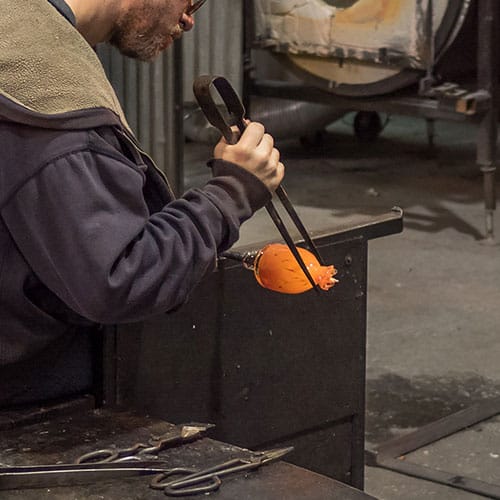
A few of the most commonly used tools are listed below, however, most glassblowers rely on many more tools to shape and handle glass.
- Block: Used to smooth and shape glass into a sphere. The block is wetted before use and the steam that is created when the block meets the molten glass helps shape it properly and prevent sticking.
- Jacks: Shapes side walls of glass.
- Crimp: Adds decorative elements by squeezing glass and creating different textures.
- Blow pipe: Gathers glass and when blown through, creates an air bubble in glass.
- Shears: Used to cut glass, can be straight or diamond shaped.
The Glassblowing Process


The glass is then gathered on the end of a blowpipe and rolled. At this stage in the process, colored glass can be added and then rerolled to ensure it is incorporated into the base glass.
The glassblower then blows through the pipe to create a bubble in the glass, giving the glass piece its shape. Throughout these steps, the glass is reheated multiple times, since it cools quickly and only hot glass is moldable. Once the desired shape has been achieved, the glassblower removes the glass from the blowpipe and lets it cool in an annealing oven, which allows the glass to cool gradually and reduces the risk of shattering.
What do Glassblowers Make?


The Processes & Tools of Lampworking
Lampworkers use a variety of small tools:
- Torch: Gives off a cool, small flame used for heating glass.
- Kiln: Cools glass slowly and in a controlled environment.
- Mandrels: Stainless steel rods around which glass is wrapped.
- Bead release formula: Prevents glass from sticking to the mandrel
- Bead Reamers: Cleans out excess material from center of beads to form the hole needed to string finished beads
- Shapers and tweezers: Used to move and shape hot glass
The Lampworking Process


What do Lampworkers Make?


Because their tools and materials are smaller and more delicate than those of glassblowers, lampworkers usually focus on creating small, detailed works of art.
Summing it Up – Just How Different Are They?
While glassblowing and lampworking are both glassworking techniques that are intertwined throughout history, they each have unique processes, tools, and finished outcomes. Glassblowing is done with large tools and thus produces larger items than lampworking, in which smaller tools are utilized to produce delicate items like beads.
The process of glassblowing involves blowing air into glass to shape it, while lampworking relies on rolling and twirling glass on a mandrel to achieve the desired shape. Therefore, the items made by lampworkers are more solid than glass blown objects, which are hollow.
These differences illustrate the complexity and diversity of glassworking as an artform. While similar in many ways, glassblowing and lampworking are distinct styles of glassworking that produce beautiful finished products that are unique from each other.
Hi!
I love your article, I’m just beginning lamp working and I would like to try hot glass someday.
Just wanted to let you know that lamp working does use hollow glass and we blow through pipes and rubber tubes. We also work on a lathe and can create large pieces but usually nothing larger than 2 litre volume.
I actually have not used a Mandrel or seen one yet !
Thanks for the article
Hello,
What temperature is glass heated to for lampworking?
Thanks