

12 Interesting Shield Types in World History [Updated]
The study of historical weapons is a popular hobby that has grown in recent years thanks to online content, video games, and tv shows.
Swords and other weapons are interesting to us because they are no longer widely used in battle today. As popular as these weapons are to the hobby researcher, shields are complementary historical objects worthy of your attention.
Shield types varied through centuries and between cultures. They have been used by militaries since ancient times.

Most societies have used shields for defense and ceremonial purposes. Our article covers diverse shield types from Egypt, China, Mediterranean empires, Europe, and southern Africa.
We’ve included some of the most famous and interesting shields in world history. This article provides a solid overview of the main shield types and is a starting point for deeper research.
1) Egyptian Cowhide Shield


Egypt was a major power in ancient times, yet we do not often learn about the types of weapons and defensive objects Egyptian fighters utilized.
From the Predynastic era to the Middle Kingdom, Egyptians relied on cowhide shields for protection in battle. These shields were rectangular in shape with tapered tops.
Ancient Egyptian shields came in a range of sizes depending on the weapon utilized in battle.
2) Double Arc Shield


The ancient Chinese of the Shang Dynasty crafted and carried shields made of hide and wooden frames. The earliest shields were large rectangles with wide bottoms and intricate decorations.
Shields of the Zhou, Spring and Autumn, and Warring States Periods took on the now-famous “double arc” shape. These shields were also created from lacquered hide on wood.
These shields were used from around 770 BC to 420 AD. In later periods, the double arc shield shrunk to the size of a European buckler (described below).
Some variations of the double arc shield were made of bronze, but the weight of these variations made them less popular than their wooden counterparts.
3) Mycenaean Shields

_at_the_National_Archaeological_Museum_of_Athens_on_October_6,_2021.jpg)
The Mycenaean people of the ancient Mediterranean are known for their art and advanced culture. The Mycenaeans utilized two main shield types.
The tower shield was a large rectangular shield that provided protection for the entire body prior to the development of bronze armor.
Tower shields were crafted from layers of hardened bull hide attached to a wooden frame. Starting in the 15th century BC, Mycenaeans started using the “figure of eight” or “figure eight” shaped shield.
These shields featured a 3D curved design that enclosed the soldier and offered superior protection.
4) Aspis


The aspis is a round shield used by ancient Greek hoplite soldiers. This is one of the most famous shield types in the world due to its appearances in tv, movies, and art.
This shield type featured a deeply curved shape that averaged two feet in diameter. The apsis could weigh as much as 16 pounds and provided superior protection from the shoulder to the knee.

_in_the_National_Archaeological_Museum_of_Athens_on_3_April_2018.jpg)
The design of the shield allowed it to be used for other purposes than defense in battle. The hollow shaped aspis was utilized as a flotation device in some instances.
5) Celtic Shields

.jpg)
The ancient Celts of the Iron Age were masters of shield design. The most famous examples of Celtic shields were actually crafted for ceremonial purposes.
Artisans made these shields from thin layers of bronze that were impractical for battle. Shields for battle were crafted from wood and leather.
Decorative Celtic shields have a signature oval or rectangular shape and decorations.
One of the most famous Celtic shields is the Battersea Shield found in 1855 in the River Thames. This shield features reliefs, engravings, and other decorative elements. It is currently displayed in the British Museum.
6) Wicker Shield

_(14801744843).jpg)
The wicker shield was used by Sparabara shield bearers of the Achaemenid Persian Empire. Cyrus the Great founded this empire in 550 BC.
These unique shields were used by the infantry. Their rectangular shape was useful for shield wall formations, and the wicker construction made these shields extremely light to carry.
Although flimsy compared to other shields, wicker shields held up against armies in the Persian area. The shield was not effective against the shields of the Greek hoplites.
7) Scutum


The scutum is another recognizable shield type that is featured in historical tv shows and movies. The Romans and other Italic people used the scutum.
This shield gained popularity in the 4th century BC as the Roman army transitioned to the use of maniple formations. The rectangular shield has a curved shape that protected soldiers from the front and sides.
The scutum’s shape made it ideal for shield wall formations and the testudo, or turtle shell, formation. Soldiers covered their heads with the shields in a group formation to protect against projectiles.
Scutum shields weighed 22 pounds and measured 42 inches in height. The shields were crafted from strips of wood arranged in layers.
The only surviving example of a scutum shield (pictured above) is housed at Yale. It is painted with Roman iconography.
8) Kite Shield


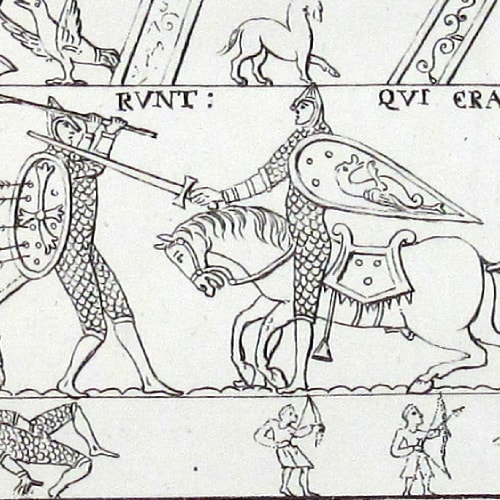
Kite shields were almond-shaped shields used by Norman soldiers in the Middle Ages. They are featured on the famous Bayeux Tapestry, which illustrates the Battle of Hastings.
The kite shield’s design made it ideal for cavalry. The shield protected the entire side of the body on horseback. This design spread throughout Europe in the 1000s and was introduced to the Middle East during the First Crusade.
The kite shield eventually fell out of favor as the smaller heater shield gained popularity.
9) Heater Shield


The heater shield is a famous European shield type. Cavalry and infantry used the triangular shield for protection and for displaying individual coats of arms.
The shield’s small size paired well with plate armor. Every class of soldier used heater shields because of their affordability.
By the 14th century, the heater shield was mostly used for jousting and other tournament events.
10) Pavise

_MET_DP111254.jpg)
The pavise is a large European shield that was popular in the 14th to 16th centuries. Infantrymen, archers, and crossbowmen utilized this shield on the battlefield.
The large rectangular shape and central ridge of the pavise shield made it a great source of protection for a wide range of fighters. The pavise was commonly used in siege warfare.
Pavise shields were commonly painted with intricate designs.
11) Buckler


The buckler was small shield popular in during the Renaissance period. Bucklers served as parrying devices in rapier duels. These shields had wooden cores with steel ring reinforcements.
They were carried by civilians and given as gifts to royalty like King Henry VIII.
12) Nguni Shield


The Nguni shield is the traditional shield of the Nguni people of southern Africa. There are several ethnic groups that make up the Nguni culture, including the Zulu people.
The Zulu and others historically used these oval oxhide shields for battle and ceremonial purposes. The Nguni shield measures three to five feet depending on their intended use. Battle shields were generally larger.
Warriors carried shields to lion hunts and battles with other people groups. They also served as shade and shelter.

.jpg)
Shield use in battle decreased in the 1870s following the introduction of firearms. Today, Nguni shields are utilized in ceremonies and dances.