
List of 17 Famous Medieval Knights Throughout History
Perhaps no figure represents the Middle Ages better than the knight. A symbol of chivalry, honor, and bravery, the medieval knight continues to capture the imaginations of people in the present day.
While shrouded in glory and legend, medieval knights were not simply chivalrous subjects of prose and poetry. Knights were some of the best weapons of the Middle Ages and their performance in campaigns could build or break entire kingdoms.


Medieval knights were set apart in status from other soldiers. Unlike common fighters, most knights belonged to the noble class and received special training that would someday lead to knighthood.
After fighting in a series of battles or displaying special bravery, a noble soldier would receive the honor of knighthood from a king or other person of great importance. This could involve an extensive ceremony, or could be as simple as recognition after a battle.

_issued_by_Kinney_Tobacco_Company_to_promote_Sweet_Caporal_Cigarettes_MET_DPB874168.jpg)
The following are some of the most famous knights of the European Middle Ages. While their stories span hundreds of years and many miles, they are united in their military skills and cultural contributions.
As we will see, many knights were not simply fierce fighters but also skilled leaders, mentors, and writers. No knight lived a perfect life, but the real histories of these men (and women) make them more human than the legends, songs, and stories that have come to define them.
Let’s explore the fascinating lives of these medieval heroes, beginning with the Norman Conquest of the 1000s and ending in the Protestant Reformation of the 1500s.
1) Robert Guiscard ‘The Crafty’

.jpg)
Robert Guiscard ‘The Crafty’ lived from 1015 to 1085. His nickname derived from his surname, but his actions throughout his life attest to his cleverness and capabilities.
Guiscard was a Norman knight who aimed to expand his own territory and power. He launched several successful campaigns for land.
After fighting the Byzantines and Arabs, Robert Guiscard obtained a duchy of his own in southern Italy. He continued to expand his territory throughout the 1070s.
Guiscard defeated the army of Byzantine emperor Alexios I Komnenos and had plans to march on Constantinople, but died of typhoid on his journey.
Robert Guiscard is remembered as one of the most ambitious knights of the 1000s. He is remembered in Dante Alighieri’s famous Divine Comedy (1310).
2) William of Poitiers
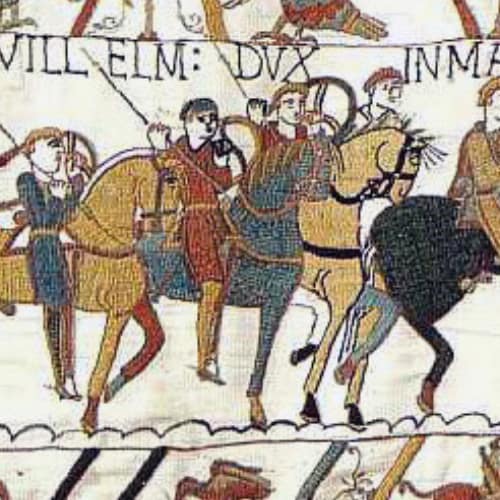

William of Poitiers lived from 1020 to 1090 and was a Norman knight, priest, and scholar. He served as the chaplain of William the Conquerer during the Norman Conquest of 1066.
While William did serve as a knight, he is best remembered for his accounts of the Norman Conquest. He was there during the Battle of Hastings and he collected the eyewitness accounts of soldiers who participated in the battle.
William of Poitiers’ writings on the Battle of Hastings have remained important primary sources for historians throughout the centuries.
3) Rodrigo Díaz de Vivar ‘El Cid’

.jpg)
Rodrigo Díaz de Vivar is best known as ‘El Cid,’ or ‘Lord.’ He lived from 1043 to 1099 and was a Spanish knight and general.
El Cid became a commander to King Ferdinand I of Castile and Leon at only 22 years old. He served the king with honor for several years until he got into a dispute with a fellow commander.
El Cid was exiled and instead served the Moorish king. He went on to gain victories agains rival Spanish and Moorish leaders and wielded the now legendary Tizona sword.
Eventually, El Cid realized he had more to gain by working for himself. He took Valencia and enjoyed his power and influence until his death in 1099.
El Cid became a legendary historical figure thanks to “The Song of the Cid,” an epic poem written in 1142.
4) Hugues de Payens


Hugues de Payens, born in 1070, is best known for co-founding the Knights Templar. He served as a Grand Master and may have fought in the First Crusade.
The Knights Templar offered protective services for pilgrims traveling to Jerusalem. Hugues de Payens gained permission from King Baldwin II of Jerusalem to extend the influence of the Knights Templar in the Holy Land.
Over time the Knights Templar became a network of banks, ship fleets, and membership chapters across Europe. Hugues de Payens continued to be an influential force until his death in 1136.
5) Sir William Marshal

.JPG)
Sir William Marshal is one of the most famous knights in English history, and has been called the “greatest knight who ever lived” by the Archbishop of Canterbury.
Born in 1146, Sir William was taken hostage by King Stephen as a young boy and was brought up as a ward to the king. His natural fighting abilities earned him a knighthood in 1166.
Sir William was extremely accomplished in tournament fighting, going 16 years undefeated. His skills caught the attention of Eleanor of Aquitaine, who employed him as tutor to her son and future king Henry.
William went on to serve this king and several others in battles against French and English rivals. During the reign of King Richard I, Sir William Marshal served as Marshal of England (hence his name). Richard spent little time in England, as he was engaged in campaigns across Europe and the Near East.
While an accomplished military professional, Sir William Marshal is also remembered and revered for co-creating and signing the Magna Carta in 1215. Sir William Marshal would pass away only a few years later in 1219.
6) Guy of Lusignan


Guy of Lusignan lived from 1150 to 1194. He was made king of Jerusalem after an advantageous marriage to the sister of King Baldwin IV of Jerusalem.
Guy of Lusignan fought in several major battles in the Near East. He lost against Saladin in the Battle of Hattin, was taken captive, and then released.
King Richard I would later name Guy of Lusignan the King of Cyprus. This knight served as a symbol of European rule and authority in the heavily disputed area of the Holy Land during the 12th century.
7) Richard I the ‘Lionheart’


King Richard I is remembered as ‘The Lionheart’ for his courage and ambitious campaigns. He was born in 1157 and became king in 1189. Supported by the French king and Eleanor of Aquitaine, Richard rebelled against King Henry II and became his successor.
During his reign, Richard I led the Third Crusade and captured Messina and Cyprus. One of his most impressive performances in battle happened in Acre near Jerusalem. Richard, then sick with scurvy, insisted upon being carried on a stretcher so he could participate in battle. He fired his crossbow from his sickbed.
Although his Third Crusade ultimately failed, Richard managed to negotiate safe passage for pilgrims to Jerusalem.
In 1192, the king was captured by the Holy Roman Empire and was ransomed after 2 years. These failures did not keep Richard from fighting battles in France and other areas of Europe.
This endless campaigner only spent 5 months of his reign in England.
8) Ulrich von Liechtenstein


The name Ulrich von Liechtenstein might conjure images of Heath Ledger in the film A Knight’s Tale, but this medieval fighter really did exist.
Ulrich von Liechtenstein was born in present-day Austria in 1200. He earned his knighthood in 1223, but he is best known for his poetic writings on medieval chivalry.
Not much is known about Ulrich von Liechtenstein’s life, but his contributions to medieval literature have helped him live on past his death in 1278.
9) Sir William Wallace


Sir William Wallace was a Scottish knight and national hero whose dramatic life is recounted in the movie Braveheart. William Wallace was born in 1270 and led raids on the Scottish-English border throughout the late 1200s.
He led the famous Battle of Stirling Bridge in 1297 and his army managed to kill around 100 English soldiers after using the narrow bridge to trap them.
Sir William Wallace led many successful campaigns against the English but lost the Battle of Falkirk in 1298. He was eventually caught and executed by the English in 1305.
10) Sir James Douglas ‘Good Sir James’


Sir James Douglas was another Scottish hero who fought for the country’s independence. He was born in 1286 and was known for his darker than usual complexion. His appearance earned him the nickname ‘The Black Douglas’ by his English opponents. Fellow scotsmen preferred to call him ‘Good Sir James.’
Sir James Douglas is remembered for recapturing his family home of Douglas Castle. It had previously been lost to Edward I of England.
Douglas also commanded the Battle of Bannockburn in 1314 and was victorious. He was nearly captured by King Edward III in 1327 in a raid, but managed to evade his enemies until his death in 1330.
11) Geoffroi de Charny


Geoffroi de Charny was a French knight born in 1309 and lived until 1356. He served King Jean II of France and carried the standard of the crown in battle.
While an accomplished fighter, Geoffroi de Charny is most famous for his contributions to literature and his idea of chivalry. He published 3 works on the subject and extolled the virtues and values of a proper knight.
Much what we understand about medieval chivalry stems from the works and ideas of Geoffroi de Charny.
12) Bertrand du Guesclin ‘The Eagle of Britany’

_-_Statue_%C3%A9questre_de_Bertrand_du_Guesclin_(de_Fr%C3%A9miet)_(50540171407).jpg)
Bertrand du Guesclin or ‘The Eagle of Brittany,’ lived from 1320 to 1380. He became a knight in 1354 after successfully stopping an English raid in Brittany.
Bertrand du Guesclin served as a constable of France after his victories in several key battles. He also served as a commander in the Hundred Years’ War (1337-1453).
The knight was just as successful in tournaments as he was in real battles.
After many years of successful fighting, Bertrand du Guesclin was captured by the English in 1364 and again in 1367. He died of dysentery in 1380.
The life of Bertrand du Guesclin is recounted in the Chronique de Bertrand du Guesclin by Cuvelier.
13) Edward of Woodstock ‘The Black Prince’


Edward of Woodstock, or ‘The Black Prince’ earned his nickname by wearing a unique all-black suit of armor and shield. He was the eldest son of Edward III and was born in 1330.
Edward of Woodstock served in the Battle of Crecy (1346) and the Battle of Poitiers (1356) during the Hundred Years’ War. He earned acclaim for his actions after these battles. The victor treated the captured French king well and distributed gold to his commanders.
Edward’s luck in battle ran out when he was captured by Bertrand du Guesclin (described above) and had to be ransomed.
The Black Prince went on to be a founding member of the Order of the Garter, which is an order of chivalry that still exists today.
14) Sir Henry ‘Hotspur’ Percy


Sir Henry ‘Hotspur’ Percy was born in 1364 and became a knight at age 13. He earned the name ‘Hotspur’ among his Scottish rivals due to his speed during battle.
Henry Percy led campaigns in Scotland, Ireland, and Prussia. He served as the Warden of East March under Richard II and patrolled the Scottish border.
The knight experienced both successes and failures during his service. He was captured in the 1388 Battle of Otterburn but was victorious in the later Battle of Homildon Hill in 1402.
Sir Henry Percy died in the Battle of Shrewsbury in 1403.
15) Jean II le Maingre

.jpg)
Jean II le Maingre lived from 1366 to 1421 and is considered by some scholars to be the last ‘true’ knight of the Middle Ages. He started out his career as a page and was knighted at age 16.
He served in the Office of Marshal and fought in Spain and Lebanon.
Jean II le Maingre’s greatest contribution to history was arguably the establishment of the White Lady of the Green Shield order, which protected the wives, daughters, and other female relatives of campaigning knights.
Since women relied on their husbands for financial and physical protection, those left behind by fighting or deceased husbands could gain this protection from Jean II le Maingre’s order.
16) Joan of Arc ‘Maid d’Orléans’


While she wouldn’t have been considered a knight by her contemporaries, scholars and history enthusiasts today believe Joan of Arc possessed all the qualities of a medieval knight.
She was born in 1412 and as a teenager heard God telling her to lead France in a campaign against the English. Joan of Arc was successful in her role as a leader and led a French victory against the English at Orléans.
She was well-loved by the French and was by Charles VII’s side during his coronation. Joan of Arc was captured by the English in 1430 and executed on charges of witchcraft.
17) Gottfried ‘Götz’ von Berlichingen

_MET_DT3270.jpg)
Gottfried ‘Götz’ von Berlichingen lived from 1480 to 1562 and served as knight and mercenary of the Holy Roman Empire.
He lost his right hand in battle and utilized prosthetics to wield weapons. This earned him the nickname ‘Götz of the Iron Hand.’
Götz served in the German Peasants’ War of the early 1500s.
Sir John Hawkwood over Joan of Arc. Give me a break. She wasn’t a knight.