
History of Samurai Literature, Legends & Writing
The Japanese samurai were the noble warrior class of society. They organized into clans with leaders who, at times, controlled Japan.
While remembered mostly for their martial arts skills and bushido moral code, the samurai were also highly educated in a wide range of skills.


The following is a brief but informative look at samurai as the subjects of Japanese literature and poetry. Samurai themselves added to the canon of Japanese literature through poetry and martial arts instructional guides.
Classical Samurai Education


As an elite class, the samurai enjoyed quality education. From a young age, samurai learned martial arts and moral lessons that would be essential for survival in battle.
Gentler topics like literature, poetry writing, tea ceremony, and flower arranging rounded out the samurai’s training. Buddhism, Confucianism, and Shintoism greatly influenced the education of samurai. Their role as the warrior class had a spiritual as well as physical component.

_Vierentwintig_Japanse_voorbeelden_van_kinderlijke_gehoor,_RP-P-1958-448.jpg)
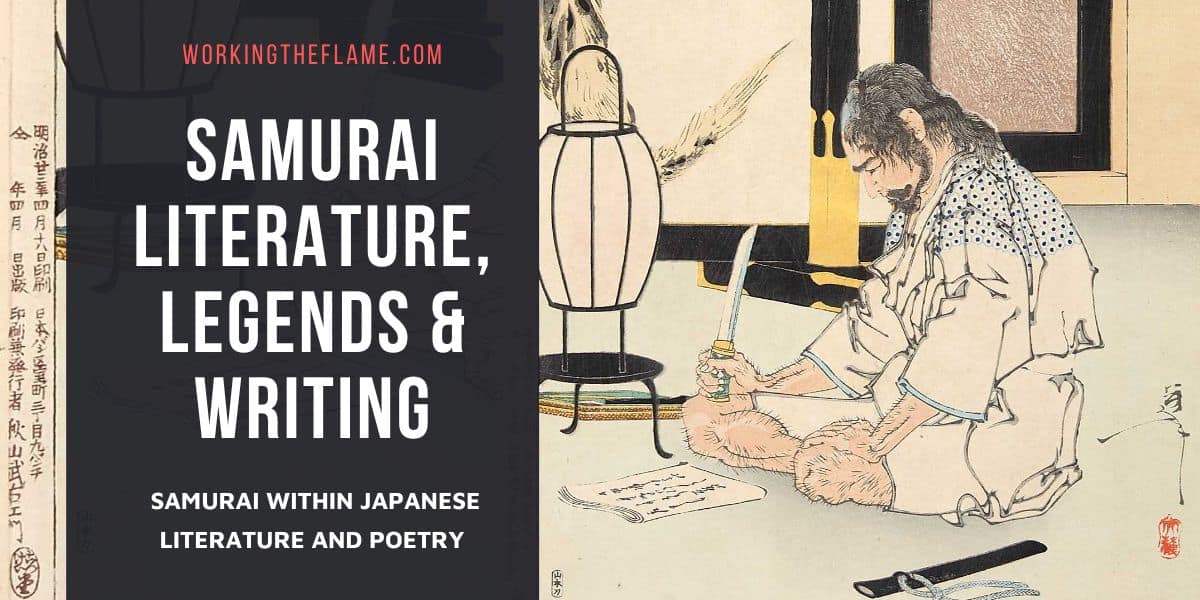
Many samurai went on to be celebrated writers in their old age. Others used their knowledge of poetry to leave behind their final words in the form of death poetry before committing seppuku, or ritual suicide.
Samurai as Writers: Poetry & Instructional Writings
As introduced above, the samurai class were educated in a broad range of topics that had benefit throughout a lifetime. Samurai learned the art of waka poetry and were familiar with Japanese literature.
The influence of different religious and philosophical streams of thought influenced the poetry of the samurai. Some of the best examples of samurai poetry are death poems.
Death poems may sound morbid to us in the present day, but to the samurai, they were an important way to say goodbye and leave a lasting impression on those they left behind.


Death poems were written before natural death or before committing seppuku. Some samurai leaned heavily on the religious and spiritual to write profound goodbyes.
Others commented on life’s futility, or even mocked the seriousness of the traditional death poem. For a samurai, poetry was as much a traditional art form as it was a highly personal form of expression.
Samurai also wrote practical clan codes of conduct and marital arts instruction guides. The Book of Five Rings by Miyamoto Musashi is a classic example of martial arts instruction written by a samurai.
Samurai Accounts, Stories, & Legends


Samurai appear in Japanese literature, folk stories, and historical accounts. These second-hand versions of a samurai’s life give another perspective and often turn the samurai into legendary heroes.
Historical accounts of Japanese warriors date to 712. The Kojiki is the oldest book that describes warriors like the samurai.
Another early account written in 787 is the Shoku Nihongi. This writing chronicles the early history of Japan and mentions the bushido code of the samurai.


By the 1300s, the samurai class had gained power and prestige in Japan. More documentation of the samurai appeared in the centuries following major events like the Genpei War.
This war between the Minamoto and Taira clans is one of the most famous historical events featuring the samurai. The story of the war is documented in the Heike Monogatari. In the story, the samurai are upheld as ideal warriors.
In both historical and fictionalized accounts, famous samurai figures, clans, and locations make their appearances. Real figures like Date Masamune and Matsudaira Nobutsuna, for example, appear in some of the classic samurai legends.