
List of Viking Armor Types & Myths Debunked [Updated]
The Vikings are some of the most popular yet misunderstood figures in European history. While many people are fans of tv shows, movies, and books chronicling the lives of Vikings, these interpretations of Viking culture are not always very accurate.
The clothing, armor, and weapons we see Vikings using in the media are designed with entertainment and drama in mind. In reality, the typical armor of the Vikings was likely far less intricate or fantastical.
Because little evidence of Viking armor exists, historians and archaeologists have differing ideas about what the average Viking warrior wore to battle.
This article aims to summarize the main pieces of Viking armor and body protection that may have been used during war and raids. While we may never be sure what Vikings actually used to protect themselves, this list gives a good idea of the types of options that may have been available in early medieval Scandinavia.
1) Gambeson & Fabric


Gambeson was protective clothing or a jacket made of thick, quilted fabric. This item existed across medieval Europe. Depending on the culture and the status of the wearer, gambeson was worn alone or under plate armor.
Experts believe that lower status Vikings may have worn gambeson or a similar garment without extra protection. This is highly speculative because no evidence of gambeson has been uncovered at Viking sites.
However, because gambeson was a common and relatively inexpensive protective option, it is very likely that lower status Vikings wore it to battle.
Besides gambeson, other types of fabric may have offered the average Viking a good level of protection. Wool would have been readily available as it was a common material in Northern Europe. Vikings valued wool clothing for its dense and durable properties.
Linen was another sturdy fabric that could have been worn to battle. Layers of linen are highly protective.
It is likely that most Vikings wore only ordinary clothing and a shield to battle.
2) Leather & Fur


Animal skins were readily available to Vikings living in Scandinavia. Evidence suggests that the Vikings managed a thriving fur trade with continental Europe, Russia, and the Byzantine Empire.
While no leather armor evidence exists, that does not mean leather was never used as protection. Animal skins decompose quicker than other materials so it is unsurprising that no evidence has been uncovered.
Because leather was used for shoes, belts, bags, saddles, and other everyday objects, it is therefore likely that leather was used for protective arm bands and other armor pieces.
Arm guards such as the ones shown above were commonly used by people groups surrounding the Vikings. It is very likely that Vikings utilized them as well.
It is also thought that Vikings relied on furs for protection in battle. Some stories tell of Viking leaders surviving sword blows thanks to heavy reindeer or bear skins.
We may never know for sure how common leather or fur armor pieces were within Viking society, but it is definitely a possibility that these items were important.
3) Chain Mail
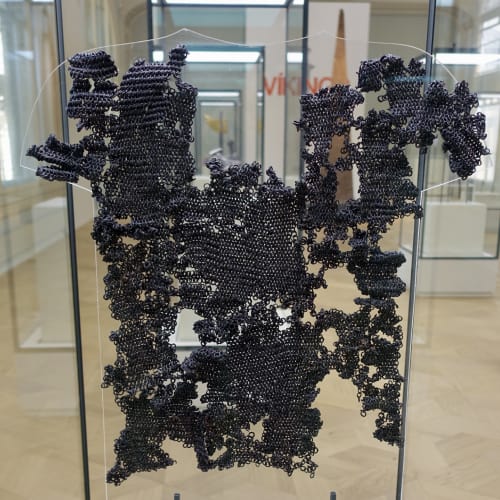
_Museum_Oslo._VIKINGR_Norwegian_Viking-Age_Exhibition_09_Parts_of_costly_chain_mail_shirt_(brynje_ringbrynje)_from_equestrian_warrior_grave_at_Gjermundbu,_950-1000_(25_000_rings_survive,_8-10_kg)_4676.jpg)
Chain mail is a very medieval type of armor, but it was not very common among the early medieval Vikings. The process of making chain mail made it an expensive armor option.
Each link of chain mail had to be riveted together by hand. A single mail shirt would have required thousands of chain links.
Only the wealthiest Vikings utilized chain mail. This expensive and valuable item would have been worn and passed down to sons. Many experts believe that only nobles and professional soldiers wore chain mail to battle.
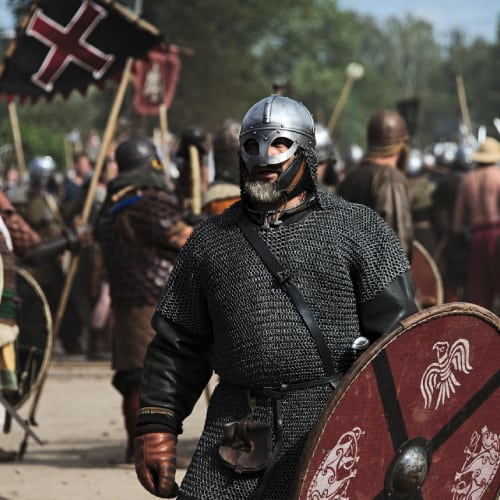

Even for wealthy Vikings, the downsides of chain mail may have made this type of armor unpopular. Chain mail was heavy and restricted free movement. The fighting style of the Vikings relied on maneuverability.
The design of chain mail did not provide complete protection. While effective at preventing cut injuries, opponents could still stab through the chain mail or wound a Viking’s head, neck, arms, and legs.
4) Lamellar


Lamellar is another type of armor that experts think Vikings may have utilized. This armor was similar to chain mail but was more popular in eastern cultures.
Lamellar was created from small iron plates sewn to a fabric or leather shirt.


Thirty individual lamellar plates were discovered in Sweden and date to between 900 and 950. It is unclear whether these plates belonged to Viking lamellar or the armor of a foreign mercenary.
5) Leg and Arm Protection
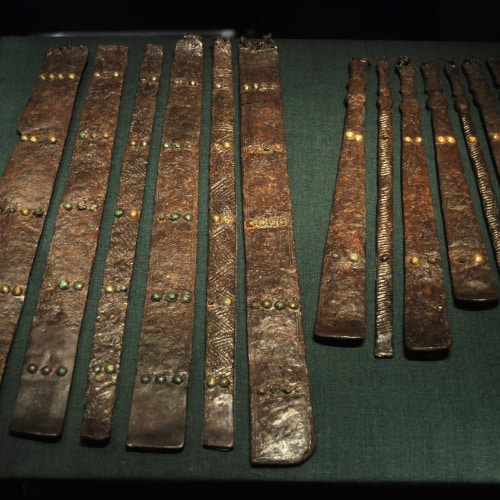

Other leg and arm protection included strips of metal and leather as shown above. These strips attached to clothing and ran vertically along a Viking’s arms and legs.
These specific strips of armor were discovered in the Valsgärde boat grave and date the 7th century.
6) Helmets


The Viking helmet is the most well-known and misunderstood part of a Viking’s armor. Helmets did not have horns or much ornamentation at all. Horns would not have been practical in battle.

_Museum_Oslo_VIKINGR_Norwegian_Viking-Age_Exhibition_08_Iron_helmet_Gjermundbu_(Gjermundbuhjelmen)_Best-preserved_viking_helmet_Grave_find_Destroyed_in_funeral_Equestrian_warrior_950-1000_(2021)_IMG_6937.jpg)
Instead, most Vikings wore simple iron cap helmets, or nothing at all. Horned helmets were saved for ritual uses.
So far, only six helmets have been uncovered in archeological digs. Experts discovered these fragments in Norway, Sweden, Denmark, Britain, and Ukraine.
7) Shields


Vikings relied on shields as their main form of defense. Because it is thought that most Vikings wore no armor at all, their main hope of survival was placed in their round shields.
Warriors used shields made of linden, fir, alder, poplar, steel, and iron. These materials were lightweight enough for easy handling while still providing ample protection. The wood types used for shields did not split easily and could withstand multiple sword blows.
Viking shields ranged in size from 45-120 centimeters (18-27 inches). Most shields measured 75-90 centimeters or 30-35 inches.
While shields offered excellent individual protection, they proved most effective when used in the shield wall formation. Vikings interlocked their shields to protect against an opponent’s spears and swords.