

Comparing Falchion & Scimitar Swords [Updated]
The falchion and scimitar swords share many similarities and are distinct in a few important ways. Both swords are of interest to history enthusiasts and collectors because of their uniquely curved shapes.
Although these swords developed during the medieval period, the cultural and physical differences between them become apparent with study.


The following is a summary of the origins, characteristics, and purposes of the falchion and scimitar swords. Photos and written descriptions of the swords’ appearances will help you better understand the similarities and differences between them.
Falchion Origins & Characteristics


The falchion is a European sword type of the Middle Ages. It features a single-edged blade that sometimes has a slight curve. The one-handed sword’s blade varied in style throughout the centuries of its use.
The shape of the blade is thought to have been adapted from Eastern European styles, which were often informed by the Near East.
Early versions of the falchion appeared in the 13th century. These swords resemble a meat cleaver or machete and are common in artwork of the period.


Cleaver-style falchions are embodied by the surviving Conyers falchion, which is displayed in England. The sword features the heraldic arms of the Plantagenets on its pommel and a wooden grip made of ash wood.
The Conyers falchion dates to approximately 1260-1270 and shares the characteristics of early cleaver falchions with its broad blade.


Later falchion swords adapted in size and shape as plate armor became more protective and common. The cusped falchion featured a clipped blade that could penetrate between armor plates. The widened blade could also be used to cut through light armor pieces.
A surviving example of the cusped falchion is the Thorpe sword. It dates to 1320 and features the sharpened tip and broadening blade of typical cusped falchions. The sword has a brass pommel decorated with monsters.

.jpg)
While the Conyers or cleaver-style falchion was common in the medieval period, few survive today. Falchions were generally poorer quality than other swords of the period and some were even crafted from broken swords.
The economical nature of the falchion made it accessible to peasants and knights alike. While cheaper than other swords of the medieval period, falchions featured cross guards that mimicked those of longswords.


Falchions could also have decorated hilts depending on the status of the wielder.
This sword style averaged 17-25 inches in length and weighed between 2 and 3 pounds. Because it was a single-handed weapon, we can expect that most falchions fit within these averages.


The falchion was a European sword accessible to those of all social ranks. While less expensive than other sword styles of the time, the falchion served its purpose as a slashing and thrusting weapon.
It evolved as plate armor advanced and proved useful in new military situations. Two famous examples survive today and represent the cleaver and cusped styles of medieval falchion swords.
Scimitar Origins & Characteristics


The scimitar is a recognizable sword that has come to represent the Middle East. The single-edged sword has a distinct curved blade.
The term “scimitar” is a catch-all name for a wide variety of Middle Eastern, North African, and South Asian swords with curved blades. The term first appeared in the 1500s. For ease of reading, we will use the term “scimitar” unless describing specific examples of sword styles.


The scimitar first appeared in the Middle East region in 9th century Persia. The sword is thought to have been adapted from styles of Central Asia. Scimitars were used through the Ottoman period (1300s to 1900s).
Curved blades were adopted by the Turks during the Mongolian invasions of the 13th and 14th centuries.

_MET_DP-653-003.jpg)
Scimitars were used for horse warfare due to their lightweight and durable construction. The curved shape of the blade was ideal for slashing opponents from horseback.
The blade’s shape made it durable, as the force of a sword strike was more evenly distributed throughout the curved blade than it would be through a straight one.
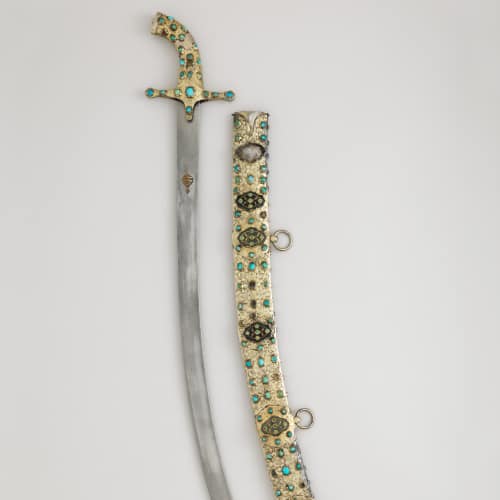

While highly practical and effective during battle, the scimitar was also a prized item that showed the wearer’s social status. Scimitars were common diplomatic gifts within the Ottoman court.
Hilts and scabbards were ornate, made from walrus ivory, iron, gold and jewels, and featured animal and flower motifs. Blades were crafted from Wootz steel, which was strong and durable high-carbon steel.
Many variations exist (see below) but in general, scimitar swords measure 30-36 inches long and weigh about 2 pounds.


As mentioned above, the scimitar category of swords includes many distinct styles from different geographical and cultural regions. Some variations are:
Kilij – Common in the 1400s, the kilij is a Turkish-style scimitar with a tapered blade.
Shamshir – A Persian scimitar with a deeply curved blade. It was popular in the 16th century and later adapted by the US Cavalry.
Talwar – An Indian scimitar sword first created in the 16th century. It has a broader blade with a softer curve than other styles. A notable feature of the Talwar is its disc-shaped pommel.


While a symbol of the Middle East and its unique history, the scimitar’s curved design caught the attention of the British and American armies in the 1900s.
The sword was adapted by European and American cavalry for use in the Napoleonic Wars and other conflicts of the nineteenth century.
Falchion vs Scimitar: Similarities and Differences
Similarities:
Both the falchion and the scimitar have unusual blade shapes. The falchion has a curved or clipped blade and the scimitar features a wide arching design.
These single-edged and one-handed swords have similar sizes and weights as well: around 30 inches (slightly shorter for the falchion) and weighing about 2 pounds.
Both have medieval and Eastern influences in their design. The falchion may have been adapted from Eastern European or Near Eastern designs, while the scimitar evolved from swords of Central Asia.
The falchion and scimitar have practical designs that worked well on the battlefield. Beyond practicality, both swords could feature intricate hilt details.
Differences:
An obvious difference between the falchion and scimitar is their geography. Although both medieval weapons, the falchion was used in Europe and the scimitar became a symbol of the Middle East.
Only two major types of falchion (cleaver and cusped) are known to us, whereas the scimitar has many variations. Scimitars have more obviously curved blades.
While the falchion was often made from recycled swords and was so cheaply made that few survive today, the scimitar was crafted from high-carbon steel and was extremely durable.
Scimitars are still used today by military around the world, while the falchion is reproduced or admired in museums.
Conclusion:
Many differences exist between the falchion and scimitar swords. Both are medieval swords with unique blade shapes, but differences in style, quality, and geography mean the falchion and scimitar are completely distinct sword types.